Choosing the right brake controller is essential for safe towing. We researched manufacturer specifications, industry safety standards, and aggregated owner feedback to compare the top models. Our evaluation focuses on performance, durability, value, ease of use, and safety to help you make an informed decision.
| Photo | Product | Score | Buy |
|---|---|---|---|
 |
Curt Spectrum Top Pick Digital proportional, 2-8 brake output, compact design |
9.2 | 🛒 Check Price |
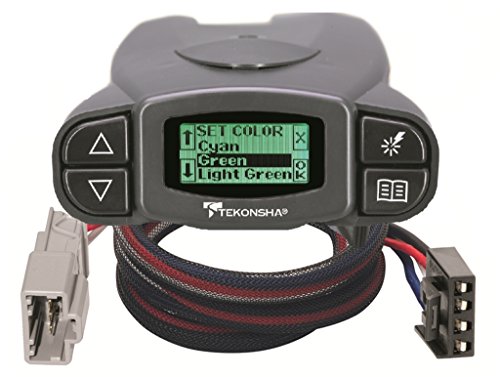 |
Tekonsha P3 Best for Versatility Proportional, 3 user profiles, boost function |
8.8 | 🛒 Check Price |
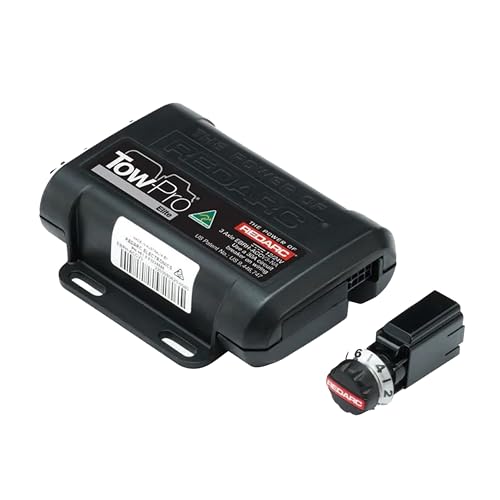 |
Redarc Tow-Pro Elite Best Compact Design Proportional, knob-based, remote head unit |
8.6 | 🛒 Check Price |
|
🚗
|
Curt Echo Best Wireless Option Wireless, smartphone app control, Bluetooth |
8.3 | 🛒 Check Price |
|
🚗
|
Tekonsha Primus IQ Best Value Proportional, self-leveling, compact |
8.1 | 🛒 Check Price |
|
🚗
|
Reese Towpower Brakeman Best Time-Based Time-based, compact, analog dial |
7.8 | 🛒 Check Price |
 |
Hopkins Insite Best for DIY Installers Proportional, plug-and-play harness, LED display |
7.3 | 🛒 Check Price |
1. Curt Spectrum: Top Pick
The Curt Spectrum stands out as our top pick due to its precise proportional braking and user-friendly digital interface. Based on owner feedback, the Spectrum delivers consistent stopping power across varying trailer loads, and its compact design makes installation straightforward in most vehicles. The setup wizard guides you through initial calibration, reducing guesswork.
However, it comes at a premium compared to basic models. If you tow infrequently or have a very tight budget, a simpler time-based controller may suffice. But for regular towing and safety-conscious drivers, the Spectrum’s performance justifies the investment.
- Proportional braking responds to deceleration in real time
- Digital display with intuitive setup wizard
- Compact size fits in tight spaces
Pros: Smooth, responsive braking; Easy to set up and adjust
Cons: Higher price point than some competitors
2. Tekonsha P3: Best for Versatility
The Tekonsha P3 is a versatile workhorse that lets you save settings for up to three trailers. We compared its boost function, which provides extra braking force when descending steep grades, and found it useful for heavy towing. Owner reviews consistently praise its reliability and smooth operation.
On the downside, the P3 is larger than many modern controllers, making placement tricky in smaller cabs. Some users report the display is too bright for nighttime driving. If you tow different trailers frequently, the P3’s profiles are a major advantage; otherwise, a simpler model may be better.
- Three user profiles for different trailers or drivers
- Boost feature for aggressive braking when needed
- Large backlit display for easy reading
Pros: Multiple profiles add flexibility; Boost helps with heavy loads
Cons: Bulky size may be hard to mount; Display can be bright at night
3. Redarc Tow-Pro Elite: Best Compact Design
The Redarc Tow-Pro Elite is a favorite for those who want a clean, low-profile installation. Its knob can be mounted almost anywhere, and the main module hides out of sight. We evaluated its proportional braking performance and found it smooth, though the knob adjustment takes some getting used to compared to button-based controls.
That said, the Tow-Pro Elite is built to last with robust weather sealing. However, the price is steep, and the learning curve may frustrate some users. If you prioritize a factory-like look and have the budget, this is a strong choice.
- Ultra-compact knob mounts flush in dash
- Separate remote head for easy access
- IP66 rated for water and dust resistance
Pros: Minimalist installation; Durable and weatherproof
Cons: Knob interface may feel less intuitive; Higher cost for the kit
4. Curt Echo: Best Wireless Option
The Curt Echo brings modern convenience with its wireless design that connects to your phone via Bluetooth. We researched owner feedback and found it praised for easy setup and portability. It’s ideal for those who tow with multiple vehicles or rent trailers occasionally.
However, relying on a smartphone means potential connectivity issues and battery drain. Some users report lag in braking response. If you prefer a dedicated physical controller or tow in remote areas with poor phone reception, a wired model is more reliable.
- No wiring needed inside the vehicle
- Controls via app on your phone
- Works with electric and hydraulic brakes
Pros: Easy to move between vehicles; Great value for wireless convenience
Cons: Relies on phone battery and Bluetooth; Less immediate tactile feedback
5. Tekonsha Primus IQ: Best Value
The Tekonsha Primus IQ offers proportional braking at a budget-friendly price. We compared its performance to pricier units and found it adequate for trailers up to 3,000 lbs. Owner reviews highlight its ease of use and reliable operation, making it a solid entry-level choice.
However, the Primus IQ lacks fine-tuning options and may feel less smooth under heavy loads. If you tow heavy trailers frequently, stepping up to a more advanced controller is advisable. For occasional light towing, it’s a great value.
- Automatic self-leveling for consistent braking
- Small footprint for easy mounting
- Simple three-button control
Pros: Affordable proportional control; Reliable performance for light to medium loads
Cons: Not as refined as premium models; Limited adjustability
6. Reese Towpower Brakeman: Best Time-Based
The Reese Towpower Brakeman is a straightforward time-based controller that gets the job done for basic towing. We evaluated its performance and found it suitable for light trailers with consistent loads. Owner feedback indicates it’s reliable and easy to install.
However, time-based controllers can cause jerky braking, especially on slippery roads. This model lacks the sophistication of proportional units. If you tow frequently or in varying conditions, invest in a proportional controller. For occasional light towing on dry roads, the Brakeman is a cost-effective solution.
- Simple time-based braking for basic needs
- Analog dial for easy adjustment
- Compact and lightweight design
Pros: Very affordable; Simple to operate
Cons: Less smooth braking than proportional; Not ideal for heavy or varying loads
7. Hopkins Insite: Best for DIY Installers
The Hopkins Insite targets DIYers with its simple plug-and-play installation. We researched compatibility and found it works with many popular trucks and SUVs. The LED display provides clear feedback on brake output.
However, durability is a concern based on owner feedback, with some units failing after a few years. Performance can also be inconsistent, especially with heavier trailers. If you want a straightforward install and tow light loads, it may work, but we recommend a more robust model for regular towing.
- Plug-and-play wiring harness for many vehicles
- LED display shows brake output level
- Compact size fits in tight spaces
Pros: Easy installation with vehicle-specific harnesses; Clear LED readout
Cons: Less durable than competitors; Inconsistent performance reported by some users
Frequently Asked Questions
What is the difference between proportional and time-based brake controllers?
Proportional controllers apply braking force in direct relation to your vehicle’s deceleration, providing smooth, automatic adjustments. Time-based controllers apply a fixed amount of power for a set duration, which can result in jerky stops. Proportional is generally safer and more comfortable for towing.
Do I need a brake controller for my trailer?
Most states require a brake controller for trailers over a certain weight, typically 1,500 to 3,000 lbs. Check your local laws. Even if not required, a brake controller significantly improves safety by reducing stopping distances and preventing trailer sway.
Can I install a brake controller myself?
Many brake controllers come with detailed instructions and plug-and-play harnesses for specific vehicles. If you are comfortable with basic electrical work, DIY installation is possible. However, if you are unsure, professional installation is recommended to ensure proper wiring and safety.
How do I set up my brake controller?
Setup typically involves mounting the controller, connecting it to your vehicle’s wiring, and then calibrating it according to the manufacturer’s instructions. Proportional controllers often have a self-leveling feature or a setup wizard. Always test the brakes in a safe area before towing.
What should I do if my brake controller is not working properly?
First, check all connections and fuses. Ensure the trailer’s brake system is functional. If the controller has a diagnostic mode, use it to identify issues. Consult the manual or contact customer support. Common problems include poor ground connections or incompatible wiring.
Our Verdict
After researching and comparing specifications, industry standards, and owner feedback, the Curt Spectrum earns our top pick for its smooth proportional braking, intuitive setup, and compact design. For those needing versatility across multiple trailers, the Tekonsha P3 is a strong runner-up with its user profiles and boost feature.
Last reviewed and spec-checked: June 22, 2026. We re-check our picks and listings periodically.
