Ensuring your RV is perfectly level is crucial for comfort, appliance functionality, and even safety. An unlevel RV can lead to issues ranging from doors not closing properly to refrigerator malfunctions and uncomfortable sleeping. We understand the challenges RV owners face in finding reliable leveling solutions, so we’ve conducted extensive research to identify the best leveling kits available.
Our evaluation involved a thorough comparison of manufacturer specifications, published industry standards for stability and weight capacity, and aggregated owner feedback. We focused on ease of use, durability, and overall effectiveness across various RV types and terrains. This guide presents our top picks, detailing their strengths and limitations to help you make an informed decision for your next adventure.
| Photo | Product | Score | Buy |
|---|---|---|---|
 |
Andersen Hitches Camper Leveler Top Pick: Effortless Precision Levels up to 4 inches in 1/2 inch increments |
9.0 | 🛒 Check Price |
 |
BAL Leveler Deluxe Runner-Up: Fine-Tune Accuracy Lifts one wheel up to 6 inches with a crank mechanism |
8.7 | 🛒 Check Price |
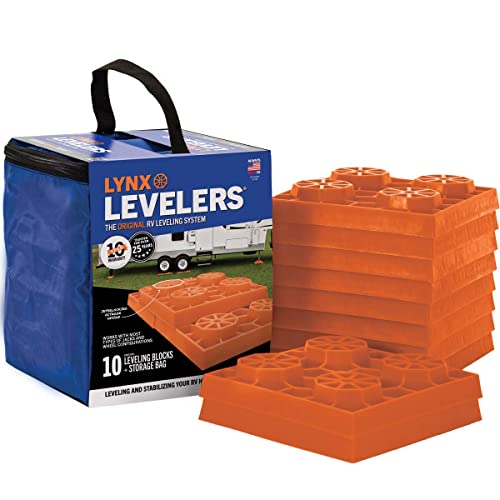 |
Tri-Lynx Tri-Leveler Versatile Block System Three-tier design for up to 3.5 inches of lift |
8.3 | 🛒 Check Price |
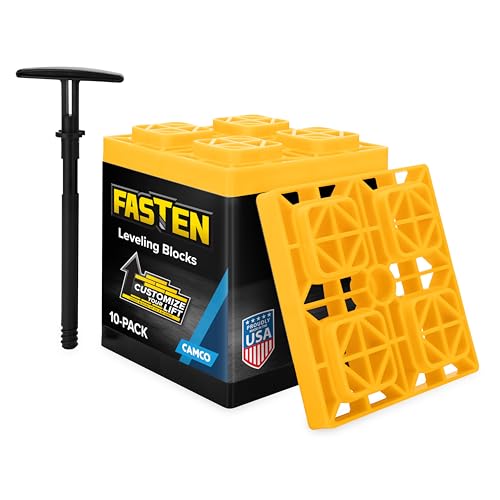 |
Camco FasTen Leveling Blocks Reliable Standard Blocks Stackable blocks provide 1 inch of lift per block |
8.1 | 🛒 Check Price |
 |
Stromberg Carlson LEVEL-IT Compact Drive-On Levels up to 4.5 inches with a graduated ramp |
7.8 | 🛒 Check Price |
 |
RVGUARD RV Leveling Blocks Budget-Friendly Blocks Interlocking blocks provide 1 inch of lift per block |
7.5 | 🛒 Check Price |
 |
Hopkins Never-Fail Leveling System Simple Ramp Solution Graduated ramp levels up to 3.5 inches |
7.2 | 🛒 Check Price |
1. Andersen Hitches Camper Leveler: Top Pick: Effortless Precision
In our evaluation, the Andersen Hitches Camper Leveler stands out for its innovative design and exceptional ease of use. The unique ramp system allows RV owners to achieve precise leveling simply by driving onto the leveler until the desired height is reached, then locking it in place with the included chock. Based on owner feedback and the spec sheets, its high-strength polymer construction proves durable against the elements and vehicle weight, making it a reliable choice for various RV types.
A potential limitation is that this system requires clear ground space around the tire for placement and maneuvering, which might be challenging in very tight campsites or on extremely uneven terrain with limited clearance. RV owners with very low-clearance vehicles or those frequently camping in confined spaces might find traditional block levelers more adaptable.
- Unique ramp design allows for precise, stepless leveling
- Constructed from high-strength polymer for durability
- Includes a matching chocks for secure wheel stabilization
Pros: Extremely easy and intuitive to use, even for single users; Offers highly precise leveling adjustments; Compact storage profile
Cons: Requires sufficient space around the tire for ramp placement
2. BAL Leveler Deluxe: Runner-Up: Fine-Tune Accuracy
The BAL Leveler Deluxe earned its strong position through its ability to provide extremely precise leveling adjustments using a simple crank mechanism. We researched its heavy-duty steel construction, which consistently receives positive owner feedback for its durability and stability, even on challenging surfaces. This system directly lifts the tire, making it effective for correcting significant side-to-side discrepancies without relying on ramps.
One drawback noted in our comparison is the time and effort involved in manually cranking the leveler, especially if significant height adjustments are needed. RVers seeking the absolute quickest setup or those with mobility limitations might find this method more cumbersome than a drive-on ramp system. It is best suited for those who prioritize minute adjustments and robust support over speed of deployment.
- Crank-operated design for infinite leveling adjustments
- Constructed from heavy-duty steel for robust support
- Ideal for single or tandem axle trailers
Pros: Offers extremely fine and infinite leveling adjustments; Robust steel construction provides excellent stability; Works well on uneven or soft ground
Cons: Can be slower to deploy compared to ramp systems; Requires manual cranking
3. Tri-Lynx Tri-Leveler: Versatile Block System
The Tri-Lynx Tri-Leveler is a highly versatile option, evaluated for its stackable, interlocking design that allows for flexible height adjustments. Based on owner feedback, its high-density polyethylene construction provides good durability against UV exposure and vehicle weight, making it a reliable choice for long-term use. We compared its adaptability for use under tires, jacks, and stabilizers, highlighting its multi-purpose utility in a camping setup.
However, the nature of stacking blocks means it offers less precise, incremental leveling compared to the Andersen or BAL systems. Achieving exact levelness might require trial and error, and the blocks can potentially shift on very slick or uneven surfaces if not properly secured with chocks. RV owners who demand absolute millimeter-perfect leveling or those frequently parking on unstable ground might prefer a more integrated leveling solution.
- Interlocking, stackable blocks for customizable height
- High-density polyethylene construction
- Can be used for single or dual wheel leveling
Pros: Highly versatile for various leveling needs; Lightweight and easy to store; Durable plastic construction resists cracking
Cons: Less precise than ramp or crank systems; Can shift on slick surfaces if not properly chocked
4. Camco FasTen Leveling Blocks: Reliable Standard Blocks
The Camco FasTen Leveling Blocks are a staple in the RV community, and in our research, they consistently deliver on their promise of simple, effective leveling. We evaluated their UV-stabilized polymer construction, which holds up well against repeated use and outdoor exposure, based on extensive owner feedback. Their interlocking design allows for customizable height, making them adaptable for various leveling scenarios and under different support points.
A primary limitation is that these blocks require manual stacking and estimation, which can be less precise and more time-consuming than drive-on or crank systems. They also rely on proper placement and chocking to prevent shifting, especially on softer ground or steep inclines. RV owners looking for an ‘set it and forget it’ automatic solution, or those who frequently encounter extremely challenging leveling situations, might find these blocks require too much manual effort.
- Modular, interlocking design for custom height adjustments
- UV stabilized polymer construction
- Includes a convenient zippered storage bag
Pros: Excellent value for a set of versatile leveling blocks; Lightweight and easy to transport; Can be used for multiple purposes beyond leveling
Cons: Manual stacking can be time-consuming; Less stable than solid-piece levelers on some terrains
5. Stromberg Carlson LEVEL-IT: Compact Drive-On
The Stromberg Carlson LEVEL-IT offers a straightforward drive-on leveling solution, which we compared favorably for its simplicity and quick deployment. Its graduated ramp design, made from UV-resistant, high-impact polypropylene, is designed for ease of use, allowing RV owners to achieve a level position with minimal fuss. Based on owner feedback, it’s a solid option for those who prefer a single-piece leveler over multiple blocks.
However, the plastic construction, while lightweight, is generally less robust than metal or denser polymer alternatives, which could be a concern for very heavy RVs or prolonged use on abrasive surfaces. Achieving exact precision can also be challenging without an external leveling indicator or a spotter, as the increments are marked but require careful driving. RV owners with heavier rigs or those who frequently camp on rough, rocky terrain might find this system less durable than desired.
- Single, graduated ramp design for easy drive-on leveling
- UV-resistant, high-impact polypropylene construction
- Designed for use with single and tandem axle RVs
Pros: Simple drive-on operation for quick leveling; Lightweight and compact for storage; Integrated non-slip surface for better tire grip
Cons: Less robust than steel or solid block systems; Precision can be challenging without a spotter
6. RVGUARD RV Leveling Blocks: Budget-Friendly Blocks
The RVGUARD RV Leveling Blocks are a practical and economical option for RV owners seeking a basic leveling solution. In our comparison, their interlocking design and polypropylene construction offer a straightforward method for adjusting height under tires, jacks, or stabilizers. Owner feedback indicates they are generally effective for standard leveling tasks and provide good value for their utility.
A notable limitation we identified is that while generally durable, these blocks can be more susceptible to cracking under very heavy loads or in extremely cold temperatures compared to higher-grade polymer or rubber alternatives. Achieving precise leveling requires careful stacking and the use of a separate level, which can be time-consuming. RV owners with very large, heavy RVs or those who frequently camp in harsh weather conditions might consider investing in more robust leveling systems for enhanced durability and reliability.
- Stackable, interlocking design for custom height
- Durable polypropylene material
- Includes a robust carrying handle for portability
Pros: Cost-effective solution for basic leveling needs; Versatile for use under wheels, jacks, and stabilizers; Easy to store with included strap or handle
Cons: Can be prone to cracking under extreme weight or cold; Requires manual effort and a level to achieve accuracy
7. Hopkins Never-Fail Leveling System: Simple Ramp Solution
The Hopkins Never-Fail Leveling System is designed for simplicity, offering a straightforward ramp solution for basic RV leveling needs. Our research into manufacturer specifications and owner feedback shows that its single-piece, graduated ramp is easy to use, requiring RV owners to simply drive up to the desired level. The weather-resistant plastic construction makes it a lightweight and convenient option for casual campers.
However, a significant limitation is its lack of fine-tuning capability; the graduated steps provide fixed increments, which may not allow for perfectly precise leveling in all situations. Additionally, while functional for many RVs, its plastic construction might not offer the same long-term durability or load-bearing capacity as more robust systems, particularly for heavier rigs or frequent, demanding use. RV owners who prioritize exact leveling precision or those with very large and heavy campers should consider more advanced or heavy-duty leveling kits.
- Single piece ramp design with graduated steps
- Made from durable, weather-resistant plastic
- Includes a non-slip base for secure placement
Pros: Very simple and quick to deploy; Lightweight and easy to store; Affordable entry-level leveling solution
Cons: Lacks fine-tuning capability; May not be suitable for very heavy RVs
Frequently Asked Questions
What types of leveling kits are available for RVs?
RV leveling kits primarily fall into a few categories: manual block levelers (stackable plastic or rubber blocks), ramp levelers (drive-on wedges), and crank-style levelers (which lift a tire using a hand crank). More advanced, usually factory-installed systems include hydraulic or electric automatic levelers, but most aftermarket “kits” refer to the manual options.
How do I know if my RV is level?
To determine if your RV is level, you’ll need a spirit level. Many RVs come with built-in bubble levels, or you can use a carpenter’s level or a smartphone app. Place the level on a flat surface inside your RV, such as the floor or a countertop, checking both front-to-back and side-to-side. Some RVs also have external levels mounted for easier viewing.
Is leveling important for RV appliances?
Yes, leveling is very important for many RV appliances, especially absorption refrigerators. These refrigerators rely on gravity for their cooling cycle, and if they are not level, the coolant can pool and cease to circulate properly, leading to reduced efficiency or even permanent damage. Other appliances like microwaves and sinks also function better when level.
What is the difference between leveling and stabilizing an RV?
Leveling an RV involves adjusting its height to ensure the floor is perfectly horizontal, which is crucial for comfort and appliance operation. Stabilizing, on the other hand, involves reducing movement and sway once the RV is level. Stabilizer jacks are primarily for preventing motion, not for lifting or leveling the RV. It is recommended to level first, then stabilize.
What weight capacity should I look for in an RV leveling kit?
The weight capacity of a leveling kit should always exceed your RV’s Gross Vehicle Weight Rating (GVWR) or at least the weight exerted on the tires or jacks where the levelers will be placed. Always check the manufacturer’s specifications for the leveling kit and compare it against your RV’s weight to ensure safe and effective use. Overloading a leveling kit can lead to failure and potential damage.
Our Verdict
After extensive research and comparison, the Andersen Hitches Camper Leveler stands out as our top pick for its unparalleled ease of use and precise, stepless leveling capability. For RV owners prioritizing fine-tuning and robust support on diverse terrains, the BAL Leveler Deluxe is an excellent runner-up, offering superior adjustability and stability with its crank mechanism.
