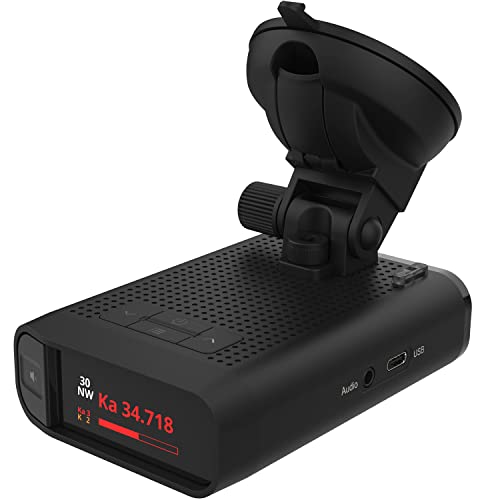
If you are comparing a radar detector vs a laser detector, here is the short answer up front: most modern units do both, but they protect you in very different ways. Laser warning is reactive, meaning the signal usually arrives the moment you are already being clocked. Radar detection is proactive, picking up signals far ahead so you can react with time to spare. That timing gap is the whole story, and it is why a quality detector blends both into one device.
For most drivers the practical takeaway is simple. You do not really choose one over the other, you choose a unit that handles each threat well. A good radar and laser detector gives you long early warning for radar and instant alerts for laser, so you are covered across the situations you actually meet on the road. Below we break down how each technology works, why both matter, and what to look for.
Radar detection: how and why it warns early
Radar works by sending out radio waves that bounce off your vehicle and return to the source, which calculates speed from the change in the reflected signal. The useful part for drivers is that radar energy spreads out and scatters across a wide area. It bounces off road signs, guardrails, and other cars long before a beam is aimed directly at you.
This scatter is exactly what a radar detector listens for. Because the signal leaks out ahead of the source, a capable detector can pick it up while you are still well back, sometimes a long distance away depending on terrain and traffic. That early warning is the proactive advantage. You get a heads up with enough time to check your speed and adjust calmly rather than slamming on the brakes.
Radar comes in a few common bands, and a strong detector covers all of them while filtering out the noise from blind spot monitoring systems on nearby cars. Good filtering is what separates a unit that cries wolf from one you actually trust day to day.
Laser (lidar) detection: fast and pinpoint, often too late
Laser, often called lidar, uses a tightly focused beam of infrared light instead of spreading radio waves. The beam is narrow and aimed directly at a single vehicle, frequently at the license plate or headlights. Because it is so precise, there is almost no scatter for a detector to grab onto in advance.
That precision is the problem for early warning. A laser detector can confirm that a beam has touched your vehicle, but by the time it alerts, your speed has usually already been recorded. This is why laser warning is described as reactive. The alert is real and accurate, yet it arrives at the moment of measurement rather than before it.
Laser detection still earns its place in a unit. It tells you the technology is in use in your area, helps you understand the threat you are dealing with, and on multi lane roads it can warn you when a vehicle ahead of you is targeted first. The value is awareness, not the same head start that radar provides.
Why you want both in one unit, and models to consider
Since radar gives proactive warning and laser gives reactive confirmation, neither covers everything on its own. The smart move is one device that handles both threats well rather than juggling separate tools. That way you get the long range early alerts radar allows along with instant laser awareness, all from a single screen and a single set of alerts.
When you compare options, focus on detection range, the quality of the filtering, and how the unit handles false alerts in busy traffic. Mounting, ease of updates, and a clear display also matter for daily use. To see how current units stack up on these points, our roundup of the best radar detectors walks through the trade offs in plain terms so you can match a model to how you actually drive.
Mistakes to avoid
- Assuming a laser alert means you have time to react. By the time laser warns, your speed has usually already been measured.
- Buying a unit weak on filtering. Constant false alerts from nearby driver assistance systems train you to ignore the device entirely.
- Mounting the detector too low or behind tinted glass, which blocks the line of sight it needs for the longest range.
- Skipping firmware and database updates, which keep detection and filtering current as conditions change.
- Treating a detector as permission to speed. It is a tool for awareness and smoother driving, not a free pass.
Bottom line
In a radar detector vs laser detector comparison, the honest conclusion is that you should not pick a side. Radar earns its keep with proactive, long range warning that gives you time to respond. Laser adds accurate, reactive awareness so you understand the exact threat in play. Each answers a different part of the problem.
The reason most modern units combine both is straightforward: drivers face both technologies, sometimes on the same trip. One quality device that does both well keeps your dashboard simple and your attention fixed on the road.
Frequently Asked Questions
Is a radar detector or a laser detector better?
Neither is strictly better because they cover different threats. Radar detection is proactive and warns you early, while laser detection is reactive and usually alerts you at the moment your speed is measured. The best answer for most drivers is a single unit that handles both.
Why does laser warning come so late?
Laser uses a narrow, focused infrared beam aimed straight at one vehicle, so there is almost no stray signal to detect in advance. By the time the beam touches your car and triggers an alert, the measurement has usually already happened.
Do I need a separate device for radar and laser?
No. Most modern detectors include both radar and laser detection in one unit. That gives you the long early warning radar allows along with instant laser awareness without managing two separate devices.
The Bottom Line
Radar and laser solve different parts of the same problem, so the goal is coverage rather than choosing one alone. Radar buys you time with early warning, and laser confirms when a precise beam is in use. Choosing the right detector means looking for strong range, smart filtering, and reliable handling of both threats, so a single device keeps you aware and your focus on driving.
Related Guides
Last reviewed: February 26, 2026.
