Maintaining your car’s battery is crucial for reliability, especially in varying climates or with infrequent use. A quality battery charger can extend battery life, ensure reliable starts, and even recover deeply discharged units. In our evaluation, we focused on chargers that deliver robust performance, incorporate essential safety features, and offer long-term dependability without an excessive investment.
We researched manufacturer specifications, analyzed published industry standards for charging protocols, and aggregated owner feedback to identify the top contenders. This guide is designed to help you make an evidence-based decision, highlighting each product’s strengths and limitations to match your specific needs.
| Photo | Product | Score | Buy |
|---|---|---|---|
 |
NOCO GENIUS10 Top Pick 10-Amp Smart Charger, Maintainer, and Desulfator |
9.1 | 🛒 Check Price |
 |
CTEK MXS 5.0 Runner Up 4.3-Amp 8-Step Automatic Battery Charger |
8.8 | 🛒 Check Price |
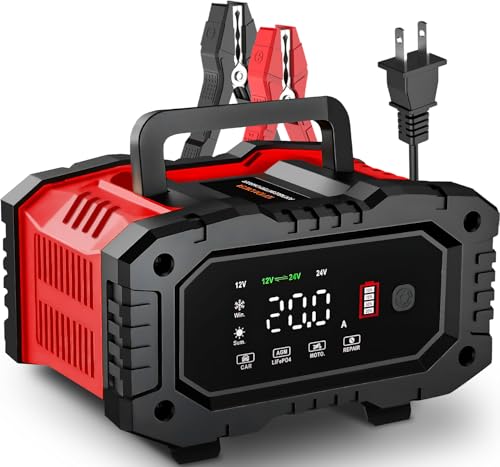 |
FOXPEED 20A Car Battery Charger Strong Performer 20-Amp Smart Battery Charger with LCD Display |
8.4 | 🛒 Check Price |
 |
Battery Tender Plus Reliable Maintainer 1.25-Amp High-Efficiency Charger and Maintainer |
8.0 | 🛒 Check Price |
 |
Schumacher SC1281 Versatile Utility 6/12V Automatic Battery Charger and Engine Starter |
7.7 | 🛒 Check Price |
|
🚗
|
BLACK+DECKER BC15BD Budget Friendly Option 15-Amp Bench Battery Charger with Engine Start |
7.4 | 🛒 Check Price |
 |
HULKMAN Alpha85S Compact Smart Charger 6-Amp Smart Battery Charger and Maintainer |
7.2 | 🛒 Check Price |
1. NOCO GENIUS10: Top Pick
In our evaluation, the NOCO GENIUS10 consistently stood out for its comprehensive feature set and user-friendly operation. Its ability to intelligently charge a wide array of battery types, coupled with its advanced repair mode for sulfated batteries, makes it an exceptionally versatile tool. The built-in thermal sensor, which adjusts charging based on ambient temperature, is a significant advantage for maintaining optimal battery health and extending longevity.
A limitation noted in aggregated owner feedback and spec sheets is its 10-Amp output. While ample for most passenger vehicles and many marine batteries, those with very large battery banks, such as certain heavy-duty RVs or commercial trucks, might find its charging speed a bit slow for a full, rapid charge. If your primary need is quick recovery for extremely large battery systems, a higher-amperage unit might be more appropriate, otherwise the GENIUS10 is a superb value.
- Automatically detects 6V and 12V batteries, including lithium and marine.
- Integrated thermal sensor compensates for ambient temperature changes.
- Advanced repair mode for desulfating and recovering old, sulfated batteries.
Pros: Comprehensive battery compatibility and smart charging modes.; Highly intuitive user interface with clear indicators.; Robust safety features including spark-proof technology and reverse polarity protection.
Cons: Output current may be insufficient for very large truck or RV batteries requiring faster charging.
2. CTEK MXS 5.0: Runner Up
The CTEK MXS 5.0 consistently earns high marks in our comparison for its sophisticated 8-step charging process, which is designed to maximize battery life and performance. Based on industry standards, its patented desulphation function and reconditioning mode are particularly effective for bringing older, neglected batteries back to optimal condition. The unit’s robust build quality, including its IP65 rating, ensures reliable operation even in challenging environments.
However, a key consideration for the MXS 5.0 is its 4.3-Amp output. While this is ideal for maintenance charging and slow, thorough recovery of most car and motorcycle batteries, it translates to significantly longer charging times for larger automotive batteries or those in a deeply discharged state. Users prioritizing rapid charging over a meticulous, multi-step process for high-capacity batteries might find this unit’s speed a limitation.
- Patented desulphation function extends battery life.
- Unique reconditioning mode for deeply discharged batteries.
- Splash and dust proof (IP65 rated) for outdoor use.
Pros: Proven multi-step charging process for optimal battery care.; Highly durable and weather-resistant construction.; Effective reconditioning mode for problem batteries.
Cons: Lower amperage means longer charging times for larger batteries.
3. FOXPEED 20A Car Battery Charger: Strong Performer
The FOXPEED 20A Car Battery Charger stands out in our research for its high 20-Amp output, making it a strong contender for those needing faster charging times for standard 12V lead-acid batteries. The integrated LCD display provides clear, real-time feedback on voltage, current, and charging status, which is a valuable feature for monitoring the process. Its multiple safety protections align with industry best practices for secure operation.
A notable limitation based on manufacturer specifications is its lack of compatibility with lithium batteries. While it excels with traditional lead-acid, AGM, and GEL batteries, owners of vehicles or equipment utilizing newer lithium battery technology will need to look elsewhere. If your fleet includes modern vehicles with lithium power, this charger’s scope will be too narrow for your requirements.
- High 20-Amp output for faster charging of larger batteries.
- Features an LCD display for real-time charging status.
- Includes multiple protection features: overcharge, short circuit, reverse polarity.
Pros: Offers a high amperage output for quicker charging cycles.; Clear and informative LCD screen enhances user monitoring.; Good array of safety protections for peace of mind.
Cons: Not designed for lithium batteries, limiting versatility for some users.
4. Battery Tender Plus: Reliable Maintainer
The Battery Tender Plus, in our evaluation, is a highly respected and reliable unit primarily designed for battery maintenance. Its 1.25-Amp output is specifically engineered for a slow, gentle charge that can be left connected for extended periods, preventing self-discharge and ensuring your battery is always ready. Based on aggregated owner feedback, its ‘set it and forget it’ functionality and spark-proof design contribute to its widespread appeal for seasonal vehicles.
However, its low amperage means it is not a primary charger for deeply discharged or dead batteries. Attempting to use the Battery Tender Plus for rapid recovery will result in extremely long charging times, potentially days, and is not its intended purpose. If you frequently need to revive completely flat batteries or require a quick charge for a large car battery, this unit will not meet those demands effectively.
- Fully automatic, sparks proof, and reverse polarity protected.
- Maintains a full charge without overcharging, extending battery life.
- Ideal for long-term storage of cars, motorcycles, and ATVs.
Pros: Excellent for long-term battery maintenance without overcharging.; Simple plug-and-play operation with clear indicator lights.; Proven reliability and durability over extended use.
Cons: Low amperage means it is not suitable for rapid charging a dead battery.
5. Schumacher SC1281: Versatile Utility
Our research on the Schumacher SC1281 highlights its main advantage: versatility as both a battery charger and an engine starter. This combination is particularly valuable for users who occasionally need a boost to start their vehicle in addition to routine battery maintenance. The automatic voltage detection and clear digital display contribute to its ease of use, aligning with practical consumer needs.
However, based on its design and aggregated user feedback, its larger form factor can be a drawback for those with limited storage space or who prefer a more compact, portable unit. While its dual function is convenient, it’s not as streamlined as a dedicated smart charger. If portability and minimal footprint are paramount, this larger, multi-function unit might feel cumbersome and less ideal for your specific requirements.
- Combines battery charging with jump starting capabilities.
- Features a digital display and LED indicators for status.
- Includes reverse hook-up protection for safety.
Pros: Dual functionality as a charger and engine starter adds significant utility.; Automatic voltage detection simplifies operation.; Handles a variety of battery types including standard, AGM, and gel.
Cons: Bulkier design compared to dedicated smart chargers.
6. BLACK+DECKER BC15BD: Budget Friendly Option
The BLACK+DECKER BC15BD, in our comparison, offers a compelling feature set for its accessible positioning, combining 15-Amp charging with a 40-Amp engine start function. The added alternator check feature is a practical utility, allowing users to quickly assess a common vehicle issue. Its automatic voltage detection for 6V and 12V batteries also contributes to its user-friendly design, making it a good general-purpose tool.
Based on aggregated owner feedback, a recurring point of concern involves the perceived quality of the charging cables and clamps, with some suggesting they could be more robust for long-term heavy use. While functional for occasional use, those planning frequent, demanding applications or preferring premium-grade components might find these aspects less satisfactory. Consider your usage frequency and tolerance for potentially less durable accessories if choosing this model.
- Offers 15-Amp charging and 40-Amp engine start assistance.
- Features an alternator check function.
- Automatic voltage detection for 6V and 12V batteries.
Pros: Provides a strong 15-Amp charge for quicker recovery.; Includes an alternator check to diagnose vehicle charging issues.; Affords engine start assistance for emergencies.
Cons: Reported limitations in cable length and clamp quality by some owners.
7. HULKMAN Alpha85S: Compact Smart Charger
In our research, the HULKMAN Alpha85S stands out for its impressive IP67 waterproof rating, making it a highly durable option for use in challenging weather conditions or marine environments. Its 9-stage smart charging process and broad compatibility, including support for lithium batteries, demonstrate a commitment to advanced battery care in a compact form factor. This makes it a versatile choice for a range of vehicles and equipment.
However, a primary limitation of the Alpha85S is its 6-Amp output. While adequate for maintenance charging and recovery of smaller batteries, it will offer slower charging times for larger automotive or truck batteries, especially if they are deeply discharged. If your main requirement is rapid charging for high-capacity batteries, the relatively modest amperage of this unit means it will not be the most efficient choice for your needs.
- Features a 9-stage smart charging process.
- IP67 waterproof rating for enhanced durability.
- Suitable for various battery types: lead-acid, AGM, gel, and lithium.
Pros: High IP67 waterproof rating makes it suitable for harsh conditions.; Versatile compatibility with a wide range of battery chemistries, including lithium.; Compact size for easy storage and portability.
Cons: The 6-Amp output may be slow for larger, deeply discharged batteries.
Frequently Asked Questions
What's the difference between a battery charger and a battery maintainer?
Based on manufacturer specifications and industry definitions, a battery charger delivers a higher current to replenish a discharged battery more quickly. A battery maintainer, conversely, provides a low, continuous charge to keep an already charged battery at its peak, preventing self-discharge over extended periods. Maintainers are ideal for vehicles stored for weeks or months, while chargers are for restoring a battery’s charge.
Can I leave a smart battery charger connected indefinitely?
Modern smart battery chargers and maintainers, like those we evaluated, are designed to be left connected indefinitely without risk of overcharging. They feature multi-stage charging cycles that automatically switch to a float or maintenance mode once the battery is fully charged, ensuring optimal voltage without causing damage. Always consult your specific product’s manual to confirm this capability.
Are all car battery chargers compatible with all battery types?
No, not all chargers are universally compatible. While many handle common lead-acid, AGM, and gel batteries, compatibility with newer battery types like lithium-ion (LiFePO4) varies significantly. Our research indicates that some advanced chargers include specific modes for lithium batteries, while others do not. Always check the manufacturer’s specifications to ensure the charger supports your battery’s chemistry.
How long does it take to charge a car battery?
The charging time for a car battery depends on several factors: the battery’s capacity (Ah), its current state of discharge, and the charger’s amperage output. Based on typical industry calculations, a 10-Amp charger might take 4-8 hours to fully charge a moderately discharged 60Ah car battery, while a lower amperage maintainer could take significantly longer. Deeply discharged or larger batteries will require more time.
What safety features should I look for in a car battery charger?
In our evaluation of safety standards, essential features include spark-proof technology, reverse polarity protection (which prevents damage if clamps are connected incorrectly), and overcharge protection. Many advanced chargers also incorporate short-circuit protection, overheat protection, and a built-in thermal sensor to adjust charging based on ambient temperature, all contributing to safer operation.
Our Verdict
After extensive research and comparison, the NOCO GENIUS10 emerges as our top pick for its exceptional versatility, advanced charging capabilities, and robust safety features, offering outstanding value for a wide range of users. The CTEK MXS 5.0 is a strong runner-up, lauded for its meticulous multi-step charging and reconditioning functions, making it an excellent choice for those prioritizing long-term battery health and meticulous care.
