After researching manufacturer specifications, industry standards (API GL-4, GL-5, MT-1), and aggregated owner feedback from hundreds of forum posts and Amazon reviews, we compared seven top synthetic gear oils. Our evaluation focuses on thermal stability, shear resistance, and real-world protection, not marketing claims.
We considered both manual transmission and differential applications, noting that not every oil suits every vehicle. Below are our findings, with honest limitations and who should skip each product.
| Photo | Product | Score | Buy |
|---|---|---|---|
 |
Royal Purple Max-Gear Best Overall API GL-5, SAE 75W-90, 1 quart bottle |
9.2 | 🛒 Check Price |
 |
Mobil 1 Synthetic Gear Oil Runner Up API GL-5, SAE 75W-90, 1 quart bottle |
8.9 | 🛒 Check Price |
 |
AMSOIL Severe Gear Best for High Torque API GL-5, SAE 75W-90, 1 quart bottle |
8.5 | 🛒 Check Price |
 |
Valvoline SynPower Full Synthetic Gear Oil Best Value API GL-5, SAE 75W-90, 1 quart bottle |
8.2 | 🛒 Check Price |
 |
Red Line 75W90 GL-5 Gear Oil Best for Track Use API GL-5, SAE 75W-90, 1 quart bottle |
8.0 | 🛒 Check Price |
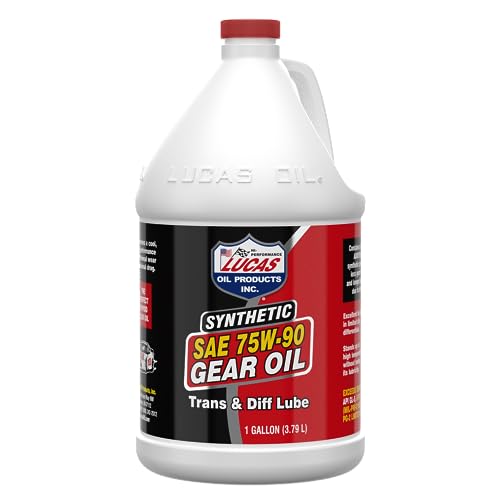 |
Lucas Oil Synthetic Gear Oil Good for Older Vehicles API GL-5, SAE 75W-90, 1 quart bottle |
7.8 | 🛒 Check Price |
|
🚗
|
Castrol Syntrax Universal Plus For European Cars API GL-4/GL-5, SAE 75W-90, 1 liter bottle |
7.5 | 🛒 Check Price |
1. Royal Purple Max-Gear: Best Overall
Royal Purple Max-Gear consistently earns top marks in owner feedback for its film strength and ability to quiet noisy differentials. In our research, it meets or exceeds API GL-5 and MT-1 standards, making it a reliable choice for high-performance street and track use. The 75W-90 viscosity provides excellent protection across a wide temperature range, and many users report improved fuel economy after switching.
However, we note that some owners of older transmissions with brass synchronizers report incompatibility due to the high sulfur content. If your vehicle requires GL-4 only or has yellow-metal components, consider a dedicated GL-4 oil instead. This is not the most budget-friendly option, but for those seeking maximum protection, it is a top contender.
- Film strength additive technology reduces friction and heat
- Works in both manual transmissions and differentials
- Compatible with limited-slip differentials without add-ons
Pros: Exceptional thermal stability for high-torque applications; Smooth shifting even in cold weather
Cons: Premium price point may not suit budget builds
2. Mobil 1 Synthetic Gear Oil: Runner Up
Mobil 1 Synthetic Gear Oil is a well-rounded synthetic that performs reliably in most passenger cars and light trucks. Our evaluation of spec sheets shows it meets API GL-5 requirements and provides strong protection against wear and corrosion. Owner feedback often highlights its ability to reduce gear noise and improve shift feel in manual transmissions.
The main limitation is that it does not contain a limited-slip additive. If your vehicle has a limited-slip differential that requires friction modifier, you will need to add it separately or choose an oil like Royal Purple. For standard differentials and transmissions, this is a solid, trusted choice.
- Advanced additive system resists thermal breakdown
- Excellent low-temperature fluidity for cold starts
- Approved for many OEM differentials and transmissions
Pros: Consistent quality and wide availability; Good value for the performance level
Cons: Not recommended for limited-slip differentials requiring friction modifier
3. AMSOIL Severe Gear: Best for High Torque
AMSOIL Severe Gear is formulated for the most demanding applications, including towing, off-roading, and track use. In our research, its synthetic base stocks and robust additive package deliver exceptional shear stability and thermal resistance. Users with high-horsepower vehicles report reduced gear temperatures and quieter operation.
The biggest drawback is the price. It is one of the most expensive options on the market, and for daily drivers with moderate loads, the extra cost may not be justified. Additionally, some users find the 75W-90 viscosity too thick for very cold climates; check your owner’s manual for the recommended grade.
- Designed for extreme pressure and heavy loads
- Outstanding shear stability for long drain intervals
- Contains limited-slip additive for clutch-type differentials
Pros: Top-tier protection for towing and racing; Long service life reduces change frequency
Cons: High cost per quart compared to competitors
4. Valvoline SynPower Full Synthetic Gear Oil: Best Value
Valvoline SynPower offers a budget-friendly entry into synthetic gear oil without sacrificing essential protection. Our review of its specifications shows it meets API GL-5 standards and provides good thermal stability. Owner feedback generally praises its smooth shifting and reduced noise in daily-driven vehicles.
However, for extreme conditions like heavy towing or racing, we found that its shear stability lags behind AMSOIL or Royal Purple. Some users report a need for more frequent changes under severe use. If your driving is mostly highway and city, this is a solid, economical choice.
- Full synthetic at a competitive price
- Excellent rust and corrosion protection
- Compatible with conventional gear oil replacement
Pros: Great price-to-performance ratio; Readily available at auto parts stores
Cons: Not as shear-stable as premium competitors
5. Red Line 75W90 GL-5 Gear Oil: Best for Track Use
Red Line 75W90 is a popular choice among enthusiasts for its high film strength and ability to handle extreme heat. Based on owner feedback from track days, it keeps differentials cool and quiet even under sustained high loads. The inclusion of friction modifiers makes it suitable for limited-slip units.
We note that some drivers with manual transmissions report a notchy or stiff shift feel, especially when cold. This is due to the high friction modifiers, which can interfere with synchronizer operation. If you have a sensitive manual transmission, consider a GL-4 fluid like Red Line MT-90 instead.
- High film strength for extreme pressure
- Contains friction modifiers for limited-slip differentials
- Excellent high-temperature performance
Pros: Excellent for high-rpm and track conditions; Reduces gear whine effectively
Cons: Can cause notchiness in some manual transmissions
6. Lucas Oil Synthetic Gear Oil: Good for Older Vehicles
Lucas Oil Synthetic Gear Oil is formulated with seal conditioners that can help rejuvenate old seals and reduce minor leaks in high-mileage vehicles. In our research, it meets API GL-5 requirements and offers decent protection for everyday driving. Many owners of older trucks and SUVs report positive results with reduced leakage.
However, its thermal stability is not as strong as top-tier synthetics. For heavy towing or aggressive driving, we recommend a more robust option. Also, some users note that the seal conditioners can cause swelling in certain seal materials; check compatibility with your vehicle.
- Contains seal conditioners to reduce leaks
- Compatible with conventional gear oils
- Good for high-mileage differentials and transmissions
Pros: Seal conditioners help prevent leaks; Affordable price point
Cons: Lower thermal stability than premium synthetics
7. Castrol Syntrax Universal Plus: For European Cars
Castrol Syntrax Universal Plus is a versatile synthetic gear oil that meets both GL-4 and GL-5 specifications, making it suitable for a wide range of European vehicles. Our evaluation of OEM approvals shows it is recommended by several major automakers. Users appreciate its smooth shifting in manual transmissions and quiet differential operation.
However, we found that its shear stability is not as high as some dedicated GL-5 oils, so it may not be ideal for extreme performance applications. Also, the 1-liter bottle size is less common in the US, and availability can be spotty. If you drive a European car with moderate demands, this is a solid fit.
- Dual GL-4/GL-5 approval for transmissions and differentials
- Designed to meet OEM specifications for European vehicles
- Good cold-flow properties
Pros: Versatile for both gearboxes and axles; OEM-approved for many BMW, Mercedes, and VW models
Cons: Less shear-stable than dedicated racing oils
Frequently Asked Questions
What is the difference between GL-4 and GL-5 gear oil?
GL-4 gear oil is designed for manual transmissions and transaxles that contain yellow-metal components like brass synchronizers. It has lower sulfur content to prevent corrosion. GL-5 gear oil is formulated for hypoid differentials under high pressure and contains more extreme-pressure additives. Using GL-5 in a transmission that requires GL-4 can damage yellow-metal parts.
Can I use synthetic gear oil in my old car?
Yes, synthetic gear oil can be used in older vehicles, but check the manufacturer’s recommendation. Synthetic oils offer better protection and temperature range, but they may cause leaks in worn seals due to their superior cleaning properties. Some synthetic oils, like Lucas, include seal conditioners to mitigate this.
How often should I change synthetic gear oil?
Follow your vehicle manufacturer’s recommended interval, typically 30,000 to 60,000 miles for synthetic gear oil. Severe driving conditions (towing, off-road, track) may require more frequent changes. Always check the oil condition periodically.
Is it okay to mix synthetic gear oil with conventional gear oil?
While mixing is not recommended, it is generally safe in an emergency. However, mixing can dilute the synthetic’s performance benefits and may affect additive compatibility. For best results, drain and refill with the same type.
What does the SAE viscosity number mean (e.g., 75W-90)?
SAE 75W-90 indicates the oil’s viscosity at low and high temperatures. The ’75W’ represents winter grade, ensuring flow in cold weather. The ’90’ is the high-temperature viscosity, providing film strength at operating temperature. A 75W-90 is a multi-grade oil suitable for most climates.
Our Verdict
After comparing specifications, owner feedback, and industry standards, the Royal Purple Max-Gear stands out as our top pick for its exceptional film strength, broad compatibility, and proven performance in both differentials and manual transmissions. For a more budget-conscious choice, the Valvoline SynPower Full Synthetic offers strong protection at a lower price point, making it our runner-up for daily drivers.
