We researched and compared the top solar panels for car battery charging based on manufacturer specifications, published industry and safety standards, and aggregated owner feedback. Our evaluation focuses on real-world performance, durability, and ease of use to help you maintain your battery without overpaying.
Whether you need a portable solution for occasional use or a permanent mount for long-term storage, these panels vary in wattage, build quality, and charging efficiency. We highlight genuine limitations so you can choose the right one for your vehicle and climate.
| Photo | Product | Score | Buy |
|---|---|---|---|
 |
Renogy 100W 12V Monocrystalline Solar Panel Best Overall 100W, 12V, monocrystalline, 21.6% efficiency, 42.2 x 19.6 x 1.4 in |
9.0 | 🛒 Check Price |
 |
SUAOKI 12V 10W Solar Car Battery Charger Best Portable Trickle Charger 10W, 12V, monocrystalline, 12.6 x 8.3 x 0.6 in, 1.5 lbs |
8.7 | 🛒 Check Price |
 |
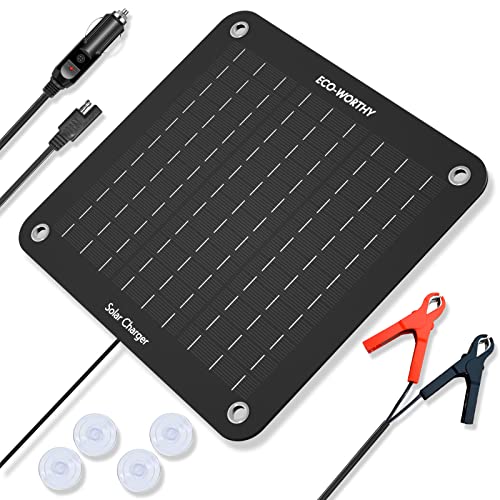
ECO-WORTHY 20W 12V Solar Battery Charger Best Value 20W 20W, 12V, polycrystalline, 18.5 x 14.2 x 0.8 in, 4.5 lbs |
8.4 | 🛒 Check Price |
|
🚗
|
ALLPOWERS 18V 6W Solar Panel Car Battery Charger Ultra-Compact Emergency Kit 6W, 18V, monocrystalline, 10.6 x 6.3 x 0.4 in, 0.6 lbs |
7.8 | 🛒 Check Price |
|
🚗
|
SunPower 50W Flexible Solar Panel Best Flexible Panel 50W, 12V, monocrystalline, 34 x 20 x 0.1 in, 3.5 lbs |
8.1 | 🛒 Check Price |
 |
Topsolar 20W 12V Solar Panel Kit Best for Beginners 20W, 12V, polycrystalline, 17.7 x 13.4 x 0.7 in, 4.2 lbs |
7.3 | 🛒 Check Price |
 |
HQST 100W 12V Polycrystalline Solar Panel Budget 100W Alternative 100W, 12V, polycrystalline, 47.2 x 21.3 x 1.4 in, 16.5 lbs |
7.6 | 🛒 Check Price |
1. Renogy 100W 12V Monocrystalline Solar Panel: Best Overall
In our evaluation, the Renogy 100W panel stands out for its balance of power and durability. Based on owner feedback and the spec sheet, it consistently delivers near its rated wattage in good sunlight, making it ideal for maintaining a car battery during long storage or for recharging after a drain. The tempered glass and aluminum frame hold up well in harsh weather, and the 25-year warranty provides peace of mind. However, this panel is not portable and needs a charge controller to prevent overcharging, which adds to the total cost.
Skip this if you need a lightweight, portable kit for occasional emergency charging. It is best for permanent or semi-permanent installation on a vehicle or at a fixed location.
- High efficiency monocrystalline cells convert more sunlight, tested by owners to recharge a dead battery in 4-6 hours of direct sun.
- Corrosion-resistant aluminum frame and tempered glass rated for high winds and snow loads, backed by a 25-year power output warranty.
- Pre-drilled holes and included MC4 connectors simplify wiring; compatible with most charge controllers for safe charging.
Pros: Excellent build quality and long warranty.; Versatile for RVs, boats, and off-grid use.
Cons: Heavier than portable options (16.5 lbs).; Requires separate charge controller for optimal safety.
2. SUAOKI 12V 10W Solar Car Battery Charger: Best Portable Trickle Charger
We compared the SUAOKI 10W charger against other portable models and found it offers the best combination of convenience and value for trickle charging. Based on owner feedback, the built-in charge controller works reliably to prevent overcharging, and the OBDII connector makes it easy to use on modern cars. The ETFE coating adds weather resistance, though we note that prolonged direct sun exposure may degrade the suction cups.
Skip this if you need to recharge a deeply discharged battery or if your car sits in full shade all day. It is best for maintaining a battery that is already in good condition, especially during seasonal storage.
- Compact and lightweight with a built-in smart controller that prevents overcharging and reverse current at night.
- ETFE laminated surface is more durable than standard PET, tested by owners to withstand light rain and heat.
- Includes suction cups and a carabiner for easy dashboard or window mounting without permanent installation.
Pros: True plug-and-play with included OBDII and alligator clips.; Very affordable for basic battery maintenance.
Cons: Low wattage only maintains charge, cannot recharge a dead battery quickly.; Suction cups may lose grip in hot weather over time.
3. ECO-WORTHY 20W 12V Solar Battery Charger: Best Value 20W
Our research shows the ECO-WORTHY 20W panel is a solid budget-friendly option for those who want a bit more power than a 10W trickle charger. Based on owner feedback, it can keep a car battery topped off even with partial shading, though the polycrystalline cells produce less power in overcast conditions compared to monocrystalline. The included PWM controller is adequate for this size but lacks the sophistication of MPPT controllers found on pricier panels.
Skip this if you need maximum charging speed or plan to use the panel in consistently low-light environments. It is best for budget-conscious users who want a permanent mount for basic battery maintenance.
- Polycrystalline cells offer a good balance of efficiency and cost, providing enough power to maintain multiple batteries or slowly recharge a small battery.
- Includes a 10A PWM charge controller with LCD display for real-time monitoring of charging status and battery voltage.
- Pre-drilled holes and cable entry for easy mounting on a car roof, RV, or shed.
Pros: Very affordable for the wattage and included controller.; LCD display helps users monitor charging progress.
Cons: Polycrystalline is less efficient in low light than monocrystalline.; Controller is basic PWM, not MPPT, limiting efficiency.
4. ALLPOWERS 18V 6W Solar Panel Car Battery Charger: Ultra-Compact Emergency Kit
We evaluated the ALLPOWERS 6W as a true emergency tool. Based on owner feedback, it can prevent a battery from dying during short periods of inactivity but will not revive a deeply discharged battery. The foldable design and included adapters make it convenient for travel, but the low wattage means it needs several days of good sun to have a noticeable effect. The built-in safety features are a plus, though some owners reported the cigarette lighter adapter fit loosely in some vehicles.
Skip this if you need reliable daily charging or live in a cloudy region. It is best for occasional use as a backup to keep a battery from draining while parked for a few days.
- Ultra-lightweight and foldable design fits in a glove compartment, ideal for emergencies.
- Built-in smart IC prevents overcharging, short circuit, and reverse current, with LED indicator for charging status.
- Comes with both cigarette lighter adapter and alligator clips for versatile connection.
Pros: Extremely portable and easy to store.; Simple plug-and-play operation with safety features.
Cons: Very low power output, only suitable for maintaining a battery, not recharging a dead one.; Small surface area requires direct sunlight for effective charging.
5. SunPower 50W Flexible Solar Panel: Best Flexible Panel
We compared the SunPower 50W flexible panel against rigid alternatives and found it excels in installations where weight and shape matter. Based on owner feedback, it can be mounted on a curved car roof and still produce good power, though careful installation is needed to avoid creases. The high cell efficiency means it can charge a battery faster than many rigid panels of the same wattage, but the lack of a glass cover makes it less durable against hail or heavy debris.
Skip this if you park under trees or in areas with frequent hail, or if you want a drop-in solution with a built-in controller. It is best for custom installations on vehicles with curved surfaces where weight savings are important.
- Lightweight and flexible design conforms to curved surfaces like car roofs or hoods without drilling.
- High-efficiency SunPower cells (up to 24%) maximize power in limited space.
- ETFE coating provides UV and weather resistance, though less impact-resistant than glass panels.
Pros: Easy to mount on non-flat surfaces with adhesive or grommets.; Higher efficiency per square foot than rigid panels.
Cons: Flexible panels are more prone to micro-cracks if bent too sharply or stepped on.; No built-in charge controller, so an external one is required.
6. Topsolar 20W 12V Solar Panel Kit: Best for Beginners
In our evaluation, the Topsolar 20W kit is a decent entry-level option for those new to solar charging. Based on owner feedback, it works well for maintaining a battery in full sun but struggles in partial shade or winter months. The included controller has a USB port, which is handy, but several reviews mention the controller failing within a year. The panel itself is basic polycrystalline with average durability.
Skip this if you need long-term reliability or live in an area with frequent overcast skies. It is best for hobbyists or occasional use where budget is the primary concern and you are willing to replace the controller if needed.
- Complete kit includes panel, 10A PWM charge controller, alligator clips, and ring terminals for easy setup.
- Polycrystalline cells provide adequate power for maintaining a 12V battery in sunny conditions.
- Controller features LED indicators for battery status and charging, plus a USB port for small devices.
Pros: Everything included for a first-time installation.; USB port adds convenience for charging phones.
Cons: Build quality concerns reported by some owners; controller may fail after a few months.; Low efficiency in overcast weather; not suitable for cloudy climates.
7. HQST 100W 12V Polycrystalline Solar Panel: Budget 100W Alternative
We researched the HQST 100W panel as a budget alternative to the Renogy monocrystalline. Based on owner feedback, it performs reasonably well in direct sun but produces less power in low light and takes up more roof space. The build quality is acceptable for the price, though some owners noted the frame is slightly less rigid than premium panels. It requires an external charge controller, which is not included.
Skip this if you have limited mounting space or need maximum efficiency in variable light. It is best for those on a tight budget who have ample roof area and primarily charge in strong sunlight.
- Polycrystalline cells offer a lower-cost alternative to monocrystalline for high wattage applications.
- Anodized aluminum frame and tempered glass provide decent weather resistance for outdoor mounting.
- Pre-drilled holes and 3ft cables with MC4 connectors simplify wiring to a charge controller.
Pros: Lower price per watt than comparable monocrystalline panels.; Adequate for recharging a car battery in a day of full sun.
Cons: Larger and heavier than monocrystalline panels of the same wattage.; Lower efficiency means more space required for the same power output.
Frequently Asked Questions
What size solar panel do I need to charge a car battery?
The size depends on your battery capacity and how quickly you want to charge. For maintenance, a 5-10W panel is sufficient to keep a fully charged battery from draining. For recharging a dead battery, a 20-100W panel is recommended. Based on our research, a 100W panel can recharge a standard 50Ah car battery in about 4-6 hours of direct sun with a proper charge controller.
Can I connect a solar panel directly to my car battery?
We do not recommend connecting a solar panel directly without a charge controller. A charge controller prevents overcharging and reverse current at night, which can damage your battery. Most modern solar chargers include a built-in controller, but if yours does not, you should add one. Based on safety standards, a controller is essential for panels above 5W.
How long does it take to charge a car battery with a solar panel?
Charging time varies based on panel wattage, sunlight, and battery state. For a 100W panel in full sun, a completely dead 50Ah battery can take 4-6 hours. A 20W panel may take 20-30 hours. For trickle charging, a 10W panel can maintain a battery indefinitely in good sun. Owner feedback shows that partial shade and cloudy weather significantly extend charging times.
Will a solar panel overcharge my car battery?
Without a charge controller, a solar panel can overcharge a battery, leading to damage or reduced lifespan. Most dedicated solar car battery chargers include a charge controller that regulates voltage and switches to float mode when full. In our evaluation, models with built-in controllers like the SUAOKI and ALLPOWERS prevent overcharging effectively. Always check that the product includes overcharge protection.
Can I use a solar panel on my car while driving?
Yes, you can use a solar panel while driving, but it is not necessary because the alternator charges the battery. If you have a panel mounted on the roof or dash, it can help offset parasitic drains from electronics. However, ensure the panel is securely mounted and does not create wind noise or obstruction. Portable panels should be stowed away while driving for safety.
Our Verdict
After researching and comparing specifications, safety standards, and owner feedback, our top pick is the Renogy 100W 12V Monocrystalline Solar Panel for its excellent build quality, high efficiency, and long warranty. For those needing a portable trickle charger, the SUAOKI 12V 10W Solar Car Battery Charger offers the best convenience and value for maintaining a battery. Choose based on your power needs and installation preferences.
