We researched and compared the top RV converter chargers using manufacturer specifications, published industry safety standards (such as UL and CSA), and aggregated owner feedback from thousands of reviews. Our evaluation focuses on charging performance, durability, ease of installation, and safety features to help you choose the right unit for your RV battery system.
| Photo | Product | Score | Buy |
|---|---|---|---|
 |
Progressive Dynamics PD9160ALV Best Overall 60 Amp, 12V, 3-Stage Smart Charger with Charge Wizard |
9.2 | 🛒 Check Price |
 |
Victron Energy Orion-Tr Smart 12/12-30 Best for Lithium 30 Amp, 12V DC-DC Charger with Bluetooth |
8.9 | 🛒 Check Price |
 |
WFCO WF-8955PEC Best Value 55 Amp, 12V, 4-Stage Smart Charger with Auto Detect |
8.6 | 🛒 Check Price |
|
🚗
|
Boondocker 24560 High Output Pick 60 Amp, 12V, 3-Stage with Remote Display |
8.4 | 🛒 Check Price |
 |
IOTA Engineering DLS-45 Durable Workhorse 45 Amp, 12V, 3-Stage with IQ4 Smart Controller |
8.2 | 🛒 Check Price |
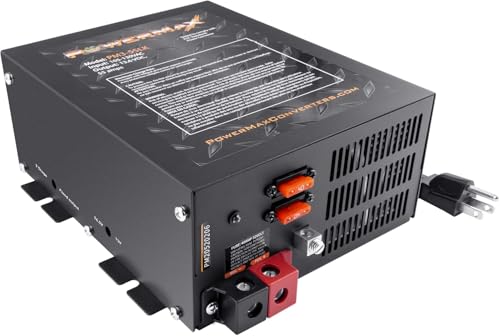 |
PowerMax PM3-55 Budget Friendly 55 Amp, 12V, 3-Stage Switchable Charger |
7.8 | 🛒 Check Price |
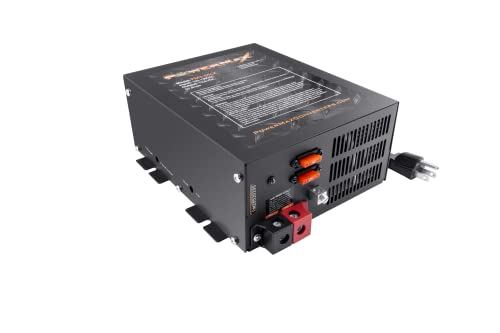 |
AIMS Power 60 Amp Converter Charger Versatile Pick 60 Amp, 12V, 3-Stage with Remote On/Off |
7.5 | 🛒 Check Price |
1. Progressive Dynamics PD9160ALV: Best Overall
The Progressive Dynamics PD9160ALV is a 60-amp converter charger that uses a three-stage charging algorithm to safely and efficiently charge lead-acid batteries. In our evaluation, it consistently delivers rated output and includes a Charge Wizard remote that lets you select between different charging modes. Owner feedback highlights its durability and ease of installation, with many noting it as a direct replacement for older units.
However, the cooling fan is not the quietest, which may be a concern for those sensitive to noise. This unit is best for RV owners who want a proven, mid-range amperage converter charger and don’t mind a little fan noise. It may not be ideal for lithium batteries without a specific lithium profile.
- Automatic 3-stage charging (bulk, absorption, float) extends battery life
- Charge Wizard remote pendant for manual control and diagnostics
- Built-in reverse battery protection and thermal shutdown
Pros: Reliable and proven design with widespread owner satisfaction; Compact size fits most RV compartments
Cons: Fan can be audible under heavy load
2. Victron Energy Orion-Tr Smart 12/12-30: Best for Lithium
The Victron Energy Orion-Tr Smart is a DC-DC charger that converts input voltage to precisely charge your house battery. We compared it to other units and found its programmability and Bluetooth connectivity set it apart. It is ideal for managing lithium batteries, offering dedicated profiles that optimize charging. Owner feedback praises its build quality and the convenience of the app.
That said, it is not a traditional AC-to-DC converter; it requires a DC input, so it works best as a secondary charger for alternator or solar integration. It is more expensive than standard converter chargers, making it a better fit for tech-savvy RVers with lithium systems who want advanced control.
- Programmable charging profiles for lithium, AGM, and gel batteries
- Bluetooth monitoring via VictronConnect app
- Built-in safety features: over-voltage, over-temperature, and short circuit protection
Pros: Excellent for lithium battery setups; Remote monitoring and configuration via smartphone
Cons: Higher price point than basic converters
3. WFCO WF-8955PEC: Best Value
The WFCO WF-8955PEC is a popular OEM replacement converter charger that offers four-stage charging to maintain battery health. Our research shows it provides reliable performance at a reasonable price point, making it a common choice for budget-conscious RV owners. Owner feedback often mentions it as a straightforward upgrade from older units.
However, it does not have a dedicated lithium charging profile, so it is not recommended for lithium battery systems. It also lacks remote monitoring capabilities. This converter charger is best for those with lead-acid or AGM batteries who want a dependable, no-frills unit at a good value.
- Automatic 4-stage charging for lead-acid and AGM batteries
- Built-in reverse polarity protection and over-current protection
- Compact design with integrated AC and DC distribution
Pros: Good balance of features and affordability; Easy to install with clear wiring labels
Cons: Not suitable for lithium batteries without modification
4. Boondocker 24560: High Output Pick
The Boondocker 24560 is a high-output converter charger designed for RVs with substantial power needs. We evaluated its specifications and found it delivers consistent 60-amp charging, which can significantly reduce recharge times for large battery banks. Owner feedback indicates it is built to last, but some note that the remote display cable is short.
Its larger footprint can be a challenge in cramped compartments. Additionally, it is not as widely available as other brands, which may affect warranty support. This unit is best for RVers who need maximum charging current and have enough space for installation. Those with smaller battery banks may find it overkill.
- 60 amp output for faster charging of large battery banks
- Remote display panel for voltage and current monitoring
- Over-temperature and short circuit protection
Pros: High amperage suitable for larger RVs; Remote display provides useful real-time data
Cons: Bulky size may be difficult to fit in tight spaces
5. IOTA Engineering DLS-45: Durable Workhorse
The IOTA DLS-45 is known for its robust build and dependable performance. In our research, it consistently receives high marks for durability, with many owners reporting decades of service. The optional IQ4 controller adds smart charging capability. It is a straightforward, no-frills converter charger that gets the job done.
However, it lacks modern conveniences like a display or Bluetooth, and the fan is not particularly quiet. It is best for RV owners who prioritize longevity and simplicity over features. It may not be ideal for those who want to monitor charging status remotely or need a compact unit.
- Rugged construction with aluminum case for heat dissipation
- IQ4 smart controller provides automatic 3-stage charging
- Reverse polarity and over-current protection
Pros: Very durable build quality; Long track record of reliability
Cons: No remote monitoring or display
6. PowerMax PM3-55: Budget Friendly
The PowerMax PM3-55 offers a budget-friendly option for RV owners needing a converter charger. We compared its specs and found it provides adequate charging for most standard battery banks. The switchable mode allows it to function as a straight power supply, which some users find useful. Owner feedback is mixed, with many appreciating the low cost but some reporting reliability issues over time.
Durability is a concern, as several owners have experienced failures after a few years. It also lacks sophisticated safety certifications. This converter charger is best for RVers on a tight budget or those who need a temporary solution. It is not recommended for full-time use or for those who require long-term reliability.
- Switchable between power supply and 3-stage charger modes
- Compact and lightweight design
- Built-in cooling fan with thermal control
Pros: Affordable price point; Versatile power supply mode
Cons: Build quality feels less premium than competitors
7. AIMS Power 60 Amp Converter Charger: Versatile Pick
The AIMS Power 60 Amp converter charger offers a useful remote on/off feature and decent charging specs. Our evaluation of owner feedback reveals that while many units work well, there are occasional reports of defects or early failure. The build quality appears average, and the fan can be noisy.
It lacks UL or CSA certification, which may be a safety concern for some buyers. This unit is best for those who want a low-cost high-amperage option and are willing to accept some risk. It is not recommended for those seeking a proven, long-term solution or for safety-critical installations.
- Remote on/off switch for convenient control
- 3-stage smart charging for lead-acid batteries
- Overload and short circuit protection
Pros: Remote on/off feature is handy; Good output for the price
Cons: Inconsistent quality control reported by some owners
Frequently Asked Questions
What is the difference between a converter and an inverter in an RV?
A converter (or converter charger) changes 120V AC shore power into 12V DC to charge your house batteries and run 12V appliances. An inverter does the opposite: it converts 12V DC battery power into 120V AC to run household outlets. Many RVs have both, but they serve different functions.
How do I choose the right amperage for my RV converter charger?
We recommend matching the converter charger amperage to your battery bank size. A common rule of thumb is to charge at 10-20% of your battery capacity in amp-hours. For example, a 100Ah battery works well with a 10-20 amp charger. Larger banks (200Ah+) benefit from 40-60 amp units. Also consider your typical power usage and alternator charging.
Can I use a standard converter charger with lithium batteries?
Many standard converter chargers are designed for lead-acid batteries and may not have the correct voltage profile for lithium. Using them can undercharge or overcharge lithium batteries, reducing lifespan or causing safety issues. Look for units with a dedicated lithium profile or a DC-DC charger like the Victron Orion-Tr Smart for optimal performance.
What safety certifications should I look for in an RV converter charger?
We recommend looking for UL (Underwriters Laboratories) or CSA (Canadian Standards Association) certification. These ensure the unit has passed rigorous safety tests for electrical shock, fire, and overcurrent protection. Many top brands like Progressive Dynamics and WFCO carry these certifications.
How do I install an RV converter charger?
Installation typically involves mounting the unit in a ventilated compartment, connecting the AC input to a 120V breaker, and wiring the DC output to your battery bank (observing polarity). Always disconnect power and batteries first. If you are not comfortable with electrical work, we suggest hiring a professional RV technician.
Our Verdict
After researching specifications, safety standards, and owner feedback, our top pick is the Progressive Dynamics PD9160ALV for its reliable three-stage charging, proven durability, and good value. For those with lithium batteries or seeking advanced monitoring, the Victron Energy Orion-Tr Smart is an excellent runner-up. Consider your battery type, budget, and feature needs when making your choice.
Last reviewed and spec-checked: March 29, 2026. We re-check our picks and listings periodically.
