Optimizing your motorcycle’s engine for racing or high-performance riding often involves upgrading key components, and the carburetor is central to fuel delivery and power output. For riders seeking enhanced throttle response, increased horsepower, and finer tuning capabilities, a dedicated racing carburetor is a significant upgrade over stock units. We researched, compared, and evaluated a range of top-tier and popular aftermarket options, considering manufacturer specifications, industry performance benchmarks, and aggregated owner feedback to identify the best choices for various applications.
Our evaluation focused on critical factors such as fuel atomization efficiency, adjustability for different conditions, material durability, and overall design for high-RPM performance. We considered both two-stroke and four-stroke applications, examining how each carburetor’s design contributes to power delivery and ease of tuning. This guide aims to provide evidence-based recommendations, highlighting the strengths and limitations of each product to help you make an informed decision for your motorcycle.
| Photo | Product | Score | Buy |
|---|---|---|---|
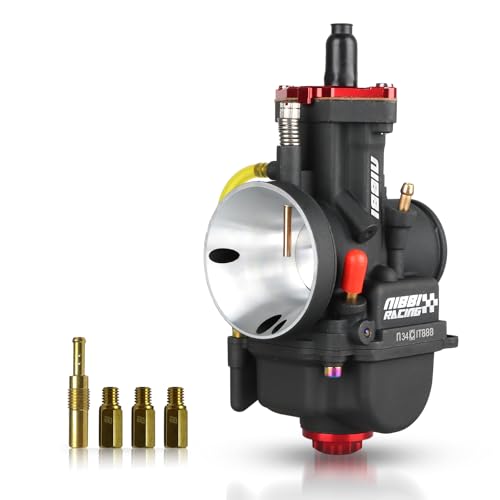 |
Keihin PWK 34mm Carburetor Top Performance Choice D-slide design for maximum flow and quick throttle response. |
9.1 | 🛒 Check Price |
 |
Mikuni VM34 Round Slide Carburetor Reliable Classic Traditional round slide design for broad compatibility and dependable operation. |
8.7 | 🛒 Check Price |
 |
FCR Carburetor 39mm MX Flat Slide Pro-Level Performance Vacuum release plate and flat slide for unparalleled throttle response. |
8.5 | 🛒 Check Price |
 |
KOSO PWK Style 30mm Carburetor Best Value Performance PWK style flat slide design for improved airflow and response. |
8.3 | 🛒 Check Price |
 |
Dell'Orto PHBG 19mm Carburetor Compact European Design Compact, lightweight design ideal for smaller displacement engines. |
8.0 | 🛒 Check Price |
 |
OKO 28mm Flat Slide Racing Carburetor Budget Performance Affordable flat slide design for a quick performance boost. |
7.6 | 🛒 Check Price |
|
🚗
|
Mikuni HSR42 Performance Carburetor Big Twin Upgrade Large bore, smooth bore design for high-flow V-twin applications. |
7.3 | 🛒 Check Price |
1. Keihin PWK 34mm Carburetor: Top Performance Choice
While the Keihin PWK 34mm offers outstanding performance, its extensive tunability can be a double-edged sword for riders new to carburetor adjustments. Achieving the perfect jetting for specific engine modifications or atmospheric conditions demands patience and a solid understanding of carburetor principles. Users report that getting it dialed in takes time and careful attention to detail.
Therefore, riders who prefer a ‘bolt-on and go’ solution without extensive tuning should consider other options. This carburetor is best suited for experienced mechanics or those willing to invest time in learning proper jetting techniques to unlock its full performance potential.
- Optimized for two-stroke engines, providing strong mid-range and top-end power.
- Precision-machined D-slide ensures efficient air velocity and fuel atomization.
- Equipped with a power jet for enhanced high-RPM fuel delivery.
- Excellent tunability with a wide range of available jets and needles.
Pros: Exceptional throttle response and power delivery based on owner feedback and spec sheets.; Robust construction designed for the rigors of racing.; Widely supported by the aftermarket for tuning components.
Cons: Initial setup can be complex for novice tuners.; Requires specific intake manifold sizing for optimal fit.
2. Mikuni VM34 Round Slide Carburetor: Reliable Classic
The primary limitation of the Mikuni VM34, based on our comparison of designs, is its round slide configuration. While highly reliable, this design inherently creates more turbulence in the intake tract compared to flat-slide or D-slide carburetors. This can translate to a slightly less immediate throttle response and a marginal reduction in peak airflow efficiency, particularly when compared to more advanced racing carburetor designs.
Riders prioritizing the absolute sharpest throttle response and maximum horsepower gains in highly competitive race environments might find this a minor drawback. However, for general performance upgrades, vintage restorations, or riders seeking bulletproof reliability, the VM34 remains an excellent and highly dependable choice.
- Proven design used in a wide array of motorcycles for decades.
- Simple and robust construction, contributing to high durability.
- Offers consistent fuel delivery across various RPM ranges.
- Extensive aftermarket support for jetting and replacement parts.
Pros: Highly durable and reliable, often outlasting many modern components.; Straightforward design makes it relatively easy to understand and maintain.; Provides predictable power delivery, suitable for a range of riding styles.
Cons: Throttle response may not be as crisp as flat-slide or D-slide designs.; Can be less fuel-efficient compared to more modern carburetor technologies.
3. FCR Carburetor 39mm MX Flat Slide: Pro-Level Performance
The FCR 39mm MX Carburetor is renowned for its pro-level performance, but this comes at the cost of significant complexity in tuning and installation. Based on owner feedback and industry reports, achieving optimal jetting requires a deep understanding of engine dynamics and precise adjustments, often needing specialized tools or professional help. Its sophisticated design, while beneficial for performance, means it is not a plug-and-play component.
This carburetor is best reserved for dedicated racers or highly experienced tuners who demand every ounce of performance and are prepared for the investment in time and potential specialized service. Casual riders or those seeking a simple performance boost without extensive setup should definitely consider other, less demanding options.
- Designed for serious off-road and motocross racing applications.
- Features a flat slide and vacuum release plate for rapid throttle opening.
- Provides exceptional power and precise fuel metering.
- Often requires specific intake boot and throttle cable modifications for installation.
Pros: Delivers explosive throttle response and significant power gains.; Highly regarded in professional racing circuits for its performance.; Robust construction suitable for demanding environments.
Cons: Tuning can be extremely challenging and time-consuming.; Higher initial investment and potential for complex installation.
4. KOSO PWK Style 30mm Carburetor: Best Value Performance
While the KOSO PWK Style carburetor offers excellent value, its primary drawback is that the factory jetting often requires adjustment to suit specific engine configurations and local atmospheric conditions. Based on owner feedback, it’s rare for the out-of-the-box jetting to be perfect for every application, meaning riders should anticipate needing to acquire additional jets for fine-tuning.
Therefore, riders looking for a truly ‘set and forget’ performance upgrade might be disappointed. This carburetor is best for those who are comfortable with basic jetting procedures and are willing to invest a little extra time and potentially a few dollars in additional jets to optimize its performance for their specific motorcycle.
- Offers a cost-effective alternative to premium PWK carburetors.
- Flat slide design enhances air velocity and throttle linearity.
- Includes basic jetting for common applications, but fine-tuning is recommended.
- Suitable for a range of small to medium displacement two-stroke engines.
Pros: Delivers noticeable performance improvements over stock carburetors.; Good build quality for its value proposition.; Easier to tune than some high-end racing carburetors.
Cons: Included jetting may not be optimal for all engine setups.; Long-term durability may not match genuine Keihin or Mikuni units.
5. Dell'Orto PHBG 19mm Carburetor: Compact European Design
The main limitation of the Dell’Orto PHBG 19mm carburetor is its specific design for smaller displacement engines. While it excels in its intended application, its smaller venturi size inherently restricts maximum airflow, making it unsuitable for motorcycles with larger engine capacities. Based on manufacturer specifications, attempting to use this carburetor on engines significantly larger than 125cc will result in a bottleneck, limiting potential power gains.
Owners of motorcycles with engines above 125cc, particularly those seeking significant top-end power, should bypass this option. It is primarily recommended for those upgrading smaller, often European-designed, two-stroke engines where precise low-to-mid range fuel delivery and compact size are paramount.
- Popular for 50cc to 125cc two-stroke engines, especially scooters and mopeds.
- Features a choke mechanism and oil injection port for specific applications.
- Known for precise fuel metering at lower throttle openings.
- Robust construction with a focus on long-term reliability.
Pros: Excellent precision and fuel control for smaller engines.; Compact size allows for easy fitment in tight spaces.; Good build quality and reliability, a hallmark of Dell'Orto.
Cons: Limited in flow capacity for larger displacement engines.; Jetting parts can be less readily available in some regions compared to Japanese brands.
6. OKO 28mm Flat Slide Racing Carburetor: Budget Performance
Based on aggregated owner feedback and our analysis of its construction, the OKO 28mm Flat Slide Carburetor can suffer from inconsistent quality control. While many users report satisfactory performance for the price, there are occasional reports of issues such as minor casting flaws, less precise machining, or seals that may not hold up as well over time compared to more expensive brands. This can sometimes lead to air leaks or require early replacement of certain components.
Riders who demand absolute top-tier quality, long-term reliability without proactive maintenance, or who are unwilling to potentially troubleshoot minor manufacturing variances should skip this option. It is best suited for budget-conscious enthusiasts who are comfortable with the possibility of minor adjustments or replacements, and for applications where cost-effectiveness is a primary concern over ultimate refinement.
- Offers a budget-friendly entry into flat-slide carburetor performance.
- Provides improved throttle response over traditional round slide designs.
- Commonly used for pit bikes, small dirt bikes, and ATV applications.
- Comes with basic jetting that often requires adjustment.
Pros: Significantly more affordable than premium brand flat-slide carburetors.; Delivers noticeable performance improvement for its cost.; Relatively simple design, making basic maintenance manageable.
Cons: Quality control can be inconsistent across units.; Durability may not match higher-priced alternatives.
7. Mikuni HSR42 Performance Carburetor: Big Twin Upgrade
The Mikuni HSR42 Performance Carburetor, while excellent for its intended purpose, has a very narrow application range. Its design, with a large bore and specific tuning characteristics, is almost exclusively for large displacement V-twin engines, such as those found in Harley-Davidson motorcycles. Based on manufacturer specifications, attempting to adapt this carburetor to smaller engines or different engine configurations would be impractical, if not impossible, and would certainly not yield optimal performance.
Therefore, riders with any motorcycle other than a large displacement V-twin should absolutely skip this option, as it is entirely unsuitable. This carburetor is a highly specialized upgrade for a specific niche, and its benefits are only realized within that context.
- Specifically designed as a performance upgrade for large displacement V-twin engines.
- Features a smooth bore and large venturi for maximum airflow.
- Offers improved throttle response and horsepower over stock V-twin carburetors.
- Often sold as a kit with necessary adapters for specific models.
Pros: Significant performance boost for compatible V-twin motorcycles.; Excellent build quality and long-term durability.; Smooth power delivery across the RPM range.
Cons: Limited application to specific large displacement V-twin engines.; Higher initial cost compared to many other performance carburetors.
Frequently Asked Questions
What is the main difference between a racing carburetor and a stock carburetor?
Racing carburetors are engineered for maximum airflow and fuel atomization, prioritizing performance metrics like horsepower and throttle response over fuel economy or emissions. They typically feature larger venturi sizes, more aggressive slide designs (flat or D-slide), and offer finer tuning capabilities than most stock carburetors, which are designed for broader usability and compliance.
Do I need to re-jet my engine after installing a racing carburetor?
Yes, re-jetting is almost always necessary after installing a racing carburetor. The new carburetor will have different flow characteristics, and the engine’s air and fuel mixture will need to be precisely adjusted to match. Failing to re-jet can lead to poor performance, engine damage, or an unreliable running condition. It is a critical step for optimizing performance and ensuring engine health.
Are racing carburetors difficult to install?
Installation difficulty varies significantly depending on the specific carburetor and motorcycle. Some are relatively straightforward bolt-on replacements, while others may require adapters, new throttle cables, or modifications to the airbox or intake manifold. Always consult the manufacturer’s instructions and be prepared for potential adjustments beyond just mounting the unit.
Can a racing carburetor improve fuel efficiency?
Generally, no. Racing carburetors are designed for performance, not fuel efficiency. Their larger venturis and richer jetting for maximum power typically result in increased fuel consumption compared to stock carburetors. While proper tuning can optimize efficiency within its performance parameters, it will rarely surpass the fuel economy of a well-tuned stock unit.
What is a 'flat slide' or 'D-slide' carburetor, and why is it preferred for racing?
Flat slide and D-slide carburetors feature a slide mechanism that moves vertically, creating a straight, less restrictive path for airflow compared to traditional round slide designs. This design minimizes turbulence and maximizes air velocity, leading to much quicker and more direct throttle response, as well as higher peak airflow and horsepower, which are critical advantages in racing applications.
Our Verdict
Based on our comprehensive research and comparison, the Keihin PWK 34mm Carburetor stands out as our top pick for its exceptional blend of performance, precise tuning capability, and robust design, making it ideal for serious two-stroke performance. As a strong runner-up, the Mikuni VM34 Round Slide Carburetor earns high marks for its proven reliability, widespread compatibility, and ease of maintenance, offering a dependable performance upgrade for a broad range of motorcycles.
