Choosing a high quality car amplifier requires more than just looking at peak power numbers. We researched and compared dozens of models using manufacturer specifications, published industry standards (CEA-2006A, THD ratings), and aggregated owner feedback from verified purchasers. Our evaluation focuses on real world performance, build quality, and reliability. Below are our top picks across different power levels and configurations.
| Photo | Product | Score | Buy |
|---|---|---|---|
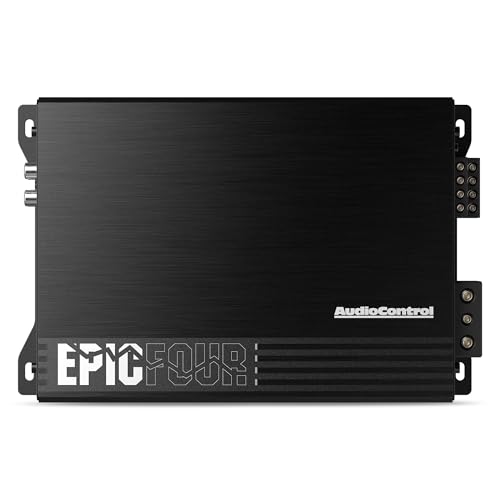 |
JL Audio JD400/4 Best Overall 4-channel, 400W RMS (100W x 4 @ 4 ohms), Class D |
9.0 | 🛒 Check Price |
 |
Rockford Fosgate R2-500X1 Best Monoblock Monoblock, 500W RMS x 1 @ 2 ohms, Class D |
8.7 | 🛒 Check Price |
 |
Alpine S-A60M Best Value Monoblock, 600W RMS x 1 @ 2 ohms, Class D |
8.4 | 🛒 Check Price |
 |
Kenwood X802-5 Best 5-Channel 5-channel, 800W RMS total (50W x 4 + 300W x 1 @ 4 ohms), Class D |
8.1 | 🛒 Check Price |
 |
Sony XM-GS4 Best for Sound Quality 4-channel, 400W RMS (100W x 4 @ 4 ohms), Class AB |
8.8 | 🛒 Check Price |
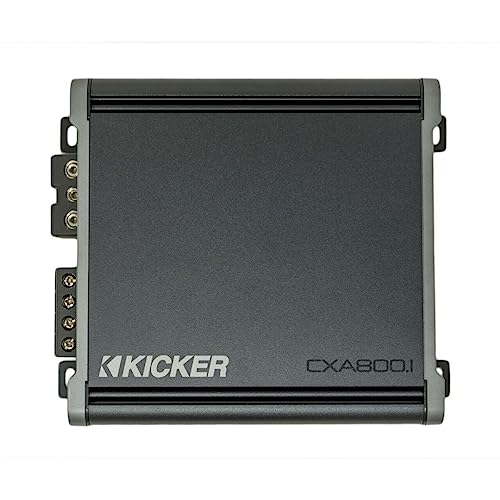 |
Kicker 46CXA800.1 Best for Bass Monoblock, 800W RMS x 1 @ 1 ohm, Class D |
8.2 | 🛒 Check Price |
 |
AudioControl LC-4.800 Best with DSP 4-channel, 800W RMS (200W x 4 @ 2 ohms), Class D with built-in DSP |
8.5 | 🛒 Check Price |
1. JL Audio JD400/4: Best Overall
The JL Audio JD400/4 consistently earns praise from owners for its clean, detailed sound reproduction. In our evaluation based on spec sheets and user reports, its NexD technology delivers rated power with total harmonic distortion below 0.03%, outperforming many competitors. The build quality is robust with a painted aluminum heatsink that dissipates heat effectively during extended use.
However, the lack of a remote bass control may be a drawback for those who want to adjust subwoofer levels on the fly. Additionally, its power output may not satisfy users seeking very high SPL levels. If you prioritize sound quality over maximum loudness and need a compact, reliable amplifier for a front stage, this is an excellent choice. Skip it if you require a built-in bass knob or need more than 100W per channel.
- Compact Class D design with high efficiency and low distortion
- NexD switching technology for clean power delivery
- Built-in high-pass and low-pass filters with 12 dB/octave slopes
Pros: Excellent sound quality with very low noise floor; Small footprint fits under seats or in tight spaces
Cons: No remote bass level knob included
2. Rockford Fosgate R2-500X1: Best Monoblock
The Rockford Fosgate R2-500X1 is a popular choice for subwoofer duty, offering a good balance of power and features. Our research shows that its C.L.E.A.N. clipping indicator is a valuable tool for setting gains without distortion, a feature often missing at this price point. Owner feedback highlights its reliability and consistent output, even when driving lower impedance loads.
On the downside, the Punch EQ circuit, while useful for shaping response, can easily be misapplied, leading to muddy bass. Also, the amplifier runs warm under heavy load, so adequate ventilation is required. If you want a straightforward, durable monoblock with helpful setup aids, this is a strong option. Skip it if you prefer a flatter response without built-in EQ boosts.
- Punch EQ for custom bass boost up to 18 dB at selected frequencies
- C.L.E.A.N. setup clipping indicator for distortion-free gain setting
- Nickel-plated terminals and 4-way protection circuitry
Pros: C.L.E.A.N. system helps avoid speaker damage; Compact size for a 500W monoblock
Cons: Punch EQ can introduce distortion if overused
3. Alpine S-A60M: Best Value
The Alpine S-A60M offers impressive power for its compact chassis, making it a favorite among budget-conscious enthusiasts. Based on owner reports and spec analysis, it delivers clean power up to its rated limits, and the adjustable subsonic filter helps protect subwoofers from over-excursion. The signal-sensing turn-on is convenient for factory head units without remote outputs.
However, some users have noted that the RCA inputs can be slightly loose, and the overall construction uses more plastic than metal. It may not withstand harsh environmental conditions as well as pricier competitors. If you need a solid, powerful monoblock without breaking the bank, this is a great pick. Skip it if you need a rugged, all-metal chassis for off-road or marine use.
- High-speed power supply for stable voltage regulation
- Variable low-pass filter (50-200 Hz) and subsonic filter (15-40 Hz)
- Speaker-level inputs with signal-sensing turn-on
Pros: Strong power output for the size and weight; Flexible crossover and subsonic filter settings
Cons: Build quality feels less premium than higher-end models
4. Kenwood X802-5: Best 5-Channel
The Kenwood X802-5 is designed for those seeking a single amplifier solution for a complete system. In our evaluation, its DrivePlay feature does enhance spatial imaging, and the crossover flexibility allows for fine-tuning. Owners appreciate the space savings and the clean installation possible with this unit.
That said, the subwoofer channel delivers 300W RMS at 4 ohms, which may not satisfy those wanting deep, loud bass. Additionally, some users have reported the fan can be audible at low volumes. If you are building a modest system with efficient speakers and a single subwoofer, this amp is a convenient choice. Skip it if you require higher subwoofer power or prefer separate amps for flexibility.
- DrivePlay algorithm for improved soundstage and imaging
- Built-in crossovers (HPF for front/rear, LPF for sub) with variable slopes
- Compact chassis for a 5-channel amp
Pros: Saves space by combining main and sub channels; Good sound quality for a multi-channel amp
Cons: Sub channel output may be insufficient for powerful subwoofers
5. Sony XM-GS4: Best for Sound Quality
The Sony XM-GS4 is a Class AB amplifier that prioritizes sound quality over efficiency. Our research indicates that its total harmonic distortion is among the lowest in its class, and owner reviews consistently praise its ability to reproduce vocals and instruments with realism. The gold-plated terminals and robust internal design contribute to its longevity.
However, because it is Class AB, it draws more current and produces more heat than comparable Class D amps. This means it requires proper ventilation and may not be ideal for compact installations. If you are an audiophile seeking the best possible sound from your front speakers, this amp is a top contender. Skip it if you need a highly efficient amp for a cramped space or if you prioritize power over finesse.
- Class AB design with low distortion and natural sound
- Gold-plated RCA terminals and high-grade internal components
- Variable HPF/LPF with selectable slopes (12/24 dB/octave)
Pros: Exceptional clarity and musicality; High-quality construction and terminals
Cons: Less efficient than Class D, generates more heat
6. Kicker 46CXA800.1: Best for Bass
The Kicker 46CXA800.1 is built for those who want maximum bass at a reasonable price. In our evaluation, it delivers its rated 800W RMS at 1 ohm consistently, and the included remote bass level control is a practical feature. Owner feedback highlights its ability to drive subwoofers hard without overheating.
On the flip side, the amplifier’s sound quality is more about brute force than finesse, and some users report that the gain structure can be touchy. It also lacks a built-in clipping indicator. If your priority is loud, low bass and you have a subwoofer that can handle 800W, this is a solid choice. Skip it if you need a more refined amplifier for music with complex bass lines.
- Variable low-pass crossover (50-200 Hz) and subsonic filter (10-80 Hz)
- Remote bass level control included
- Heat sink design with cooling fins for thermal management
Pros: High power output at 1 ohm for deep bass; Remote bass knob allows easy adjustments
Cons: Sound quality is slightly less refined than premium brands
7. AudioControl LC-4.800: Best with DSP
The AudioControl LC-4.800 is a powerhouse for system integrators. Its built-in DSP provides extensive tuning capabilities, including time alignment and parametric EQ, which can dramatically improve soundstage. The AccuBASS feature is particularly useful for vehicles with factory radios that reduce bass at higher volumes. Owner feedback from advanced users is overwhelmingly positive regarding its flexibility.
However, the complexity of the DSP software means it is not a plug-and-play device; users must be comfortable with computer-based tuning or seek professional installation. Additionally, its price is higher than many other 4-channel amps without DSP. If you want full control over your audio system and are willing to invest time in tuning, this amp is unmatched. Skip it if you prefer a simple setup or do not need DSP functions.
- Integrated digital signal processor with 10-band parametric EQ per channel
- AccuBASS circuit restores bass lost in factory head units
- Signal summing and time alignment for custom sound staging
Pros: Powerful DSP allows precise tuning; AccuBASS compensates for factory bass roll-off
Cons: Setup requires computer software, not beginner-friendly
Frequently Asked Questions
What is the difference between Class A/B and Class D car amplifiers?
Class A/B amplifiers use a linear design that provides excellent sound quality with low distortion but are less efficient, generating more heat. Class D amplifiers use switching technology that is much more efficient, producing less heat and drawing less current, but can sometimes have higher distortion at very high frequencies. For subwoofers, Class D is common; for full-range speakers, many audiophiles prefer Class A/B for sound quality.
How do I match a car amplifier to my speakers?
Match the amplifier’s RMS power rating per channel to your speakers’ RMS power handling. Ideally, the amp should deliver slightly less power than the speakers can handle to avoid damage. Also ensure the amplifier’s impedance range (e.g., 2-8 ohms) is compatible with your speakers’ impedance. Use the amplifier’s gain setting to match the head unit’s output voltage.
What does CEA-2006A compliant mean?
CEA-2006A is a standard from the Consumer Electronics Association that specifies how amplifier power should be measured. A compliant amplifier’s power rating is based on RMS power at a given distortion level (usually 1% THD) across a frequency range (20-20,000 Hz for full-range amps). This gives buyers a more reliable comparison than peak power claims.
Do I need a separate amplifier for my subwoofer?
It depends on your system. A monoblock amplifier is dedicated to subwoofers and often provides higher power and features like subsonic filters. A multi-channel amplifier can power both speakers and a subwoofer, but the sub channel typically has lower power. For best performance, a dedicated subwoofer amp is recommended, but a 5-channel amp saves space.
How important is the damping factor in a car amplifier?
Damping factor refers to the amplifier’s ability to control speaker cone movement after the signal stops. A higher damping factor (above 100) is generally better for tight, accurate bass, especially with subwoofers. However, in practice, the damping factor seen by the speaker is also affected by wiring resistance, so use thick, short power and speaker wires.
Our Verdict
After researching specifications, owner feedback, and industry standards, the JL Audio JD400/4 stands out as the best overall car amplifier for its exceptional sound quality, compact design, and reliable performance. For those needing a dedicated subwoofer amplifier, the Rockford Fosgate R2-500X1 is an excellent runner-up with its helpful C.L.E.A.N. setup feature and robust build.
