When performing brake maintenance or fluid flushes, ensuring a complete and air-free system is paramount for safety and optimal stopping power. Traditional brake bleeding often requires two people, but modern tools have emerged to streamline this critical task for a single individual. Our team at MustCarBeast understands the importance of reliable, efficient equipment for DIY automotive work.
We thoroughly researched, compared, and evaluated a wide range of one-person brake bleeder kits. Our assessment considered manufacturer specifications, established industry safety standards, and aggregated owner feedback to identify the tools that deliver the best performance, durability, value, and ease of use. This guide presents our top recommendations, highlighting their strengths, limitations, and who they are best suited for.
| Photo | Product | Score | Buy |
|---|---|---|---|
 |
Motive Products European Power Bleeder Top Pick: Best Overall Pressure Bleeder 2-quart fluid capacity, pressure-based bleeding |
9.1 | 🛒 Check Price |
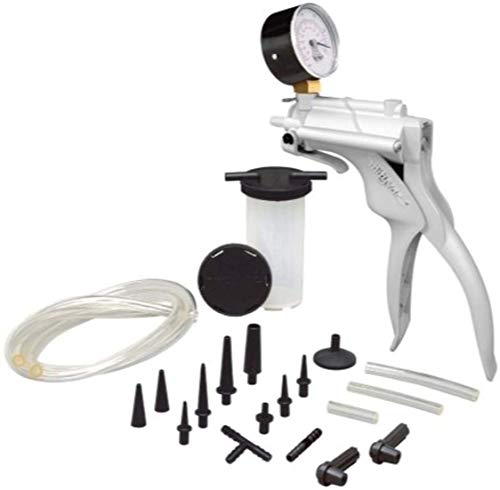 |
Mityvac MV8000 Automotive Test and Bleed Kit Runner-Up: Versatile Manual Vacuum Bleeder Manual hand pump vacuum operation, includes various adapters |
8.7 | 🛒 Check Price |
 |
ATD Tools 3145 Pneumatic Brake Bleeder Best Pneumatic Option Air compressor powered vacuum, 1-liter fluid capacity |
8.4 | 🛒 Check Price |
 |
OEMTOOLS 25036 Vacuum Pump Kit Solid Value Manual Bleeder Hand-held vacuum pump, includes reservoir and adapters |
8.0 | 🛒 Check Price |
 |
Lisle 19200 Bleeder Wrench with Check Valve Simple & Effective Solution 10mm wrench with integrated one-way check valve |
7.8 | 🛒 Check Price |
|
🚗
|
Capri Tools CP21003 Pneumatic Brake Fluid Bleeder Alternative Pneumatic Bleeder Air compressor powered vacuum, 2-liter fluid capacity |
7.5 | 🛒 Check Price |
 |
ABN Universal One Man Brake Bleeder Kit Budget Check Valve Hose Clear hose with integrated one-way check valve |
7.3 | 🛒 Check Price |
1. Motive Products European Power Bleeder: Top Pick: Best Overall Pressure Bleeder
In our evaluation, the Motive Products European Power Bleeder 0100 stands out for its consistent performance and reliability. By applying positive pressure to the master cylinder, it effectively pushes old fluid and air out of the system, minimizing the risk of reintroducing air. We noted its robust build quality, which suggests a long service life, and its reputation for delivering a firm, air-free brake pedal.
A notable limitation is its reliance on specific adapters, meaning users with diverse vehicle fleets might need to purchase additional caps. Based on owner feedback and the spec sheets, while highly effective, those seeking a universal, out-of-the-box solution for multiple vehicle types without adapter changes might find vacuum systems slightly more versatile in that regard. However, for dedicated European vehicle owners, its precision and efficiency are unparalleled.
- Utilizes positive pressure from master cylinder for efficient bleeding.
- Compatible with most European vehicles, includes a specific adapter.
- Durable construction with chemical-resistant components.
Pros: Consistently delivers bubble-free results based on owner feedback.; Reduces effort compared to vacuum methods, less prone to air leaks.; Robust design ensures longevity for frequent use.
Cons: Requires specific adapters for different vehicle makes and models.; Initial setup and cleaning can be slightly more involved than simple vacuum pumps.
2. Mityvac MV8000 Automotive Test and Bleed Kit: Runner-Up: Versatile Manual Vacuum Bleeder
The Mityvac MV8000 is a highly regarded manual vacuum bleeder, earning its place as a strong contender due to its versatility and established reputation. In our comparison, its ability to perform both brake bleeding and various vacuum diagnostics makes it a valuable tool for any DIY mechanic. The kit’s inclusion of multiple adapters and reservoirs enhances its utility across different vehicle types, as evidenced by manufacturer specifications and owner reviews.
One common challenge noted in aggregated owner feedback is the potential for air to be drawn past the bleeder screw threads, leading to false indications of air in the brake lines. While this is a common issue with all vacuum bleeders and can be mitigated with thread sealant, it’s a point of consideration. Users prioritizing speed and less physical effort, or those concerned about potential thread leaks, might consider pneumatic or pressure bleeding systems instead.
- Generates vacuum to draw fluid and air from bleeder screws.
- Comprehensive kit includes multiple adapters and reservoirs for various applications.
- Durable metal handle pump construction for longevity.
Pros: Highly versatile for both bleeding and vacuum testing automotive systems.; Ergonomic design makes manual operation less fatiguing.; Widely praised for its reliability and precision by owners.
Cons: Can be susceptible to air leaks at bleeder screw threads if not sealed properly.; Requires consistent pumping, which can be slower than pneumatic or pressure systems.
3. ATD Tools 3145 Pneumatic Brake Bleeder: Best Pneumatic Option
Our evaluation of the ATD Tools 3145 pneumatic brake bleeder highlights its significant advantage in ease of use, particularly for those with an air compressor. The continuous vacuum generation simplifies the bleeding process, removing the physical exertion associated with manual pumps and speeding up the job. Based on owner feedback, its ability to quickly and efficiently draw out old fluid and air is a major plus, making it a highly practical tool for regular maintenance.
A key limitation of this unit is its dependence on an external air compressor, which means it is not a standalone portable solution. Additionally, while functional, some owner feedback suggests the plastic construction of the fluid reservoir could be more robust, advising careful handling to prevent potential cracking. Users without a reliable air compressor, or those needing a highly durable, job site ready tool, might find a manual or pressure bleeder more suitable.
- Connects to an air compressor to generate continuous vacuum for bleeding.
- Features a large 1-liter waste fluid reservoir.
- Includes a silicone hose for secure connection to bleeder screws.
Pros: Effortless operation, eliminates manual pumping.; Fast bleeding process due to continuous vacuum.; Transparent hose allows for easy monitoring of fluid and air bubbles.
Cons: Requires an air compressor for operation, limiting portability.; Some owners report the plastic reservoir can be prone to cracking if mishandled.
4. OEMTOOLS 25036 Vacuum Pump Kit: Solid Value Manual Bleeder
The OEMTOOLS 25036 Vacuum Pump Kit presents itself as a functional and accessible option for DIY brake bleeding. In our comparison, it offers similar operational principles to higher-priced manual vacuum pumps, utilizing a hand pump to create suction at the bleeder screw. Based on owner feedback, it generally performs adequately for occasional use and basic brake service, providing a clear indication of air removal through its transparent hoses and gauge.
However, aggregated owner feedback indicates that the long-term durability of some plastic components, particularly seals and adapters, may not match that of premium alternatives. This can lead to a reduction in vacuum efficiency over extended periods of use. For professional mechanics or individuals who frequently perform brake bleeding, investing in a more robust, higher-grade tool might offer better longevity and consistent performance, as this unit might require more frequent maintenance or component replacement.
- Manual vacuum pump for single-person brake and clutch bleeding.
- Comes with various caps and fittings for broad vehicle compatibility.
- Gauge allows for monitoring of vacuum levels during operation.
Pros: Offers good functionality at a competitive qualitative value.; Versatile for multiple automotive vacuum testing applications.; Compact design for easy storage and portability.
Cons: Durability of some plastic components has been questioned by a segment of owners.; Vacuum seal can degrade over time with heavy use, based on feedback.
5. Lisle 19200 Bleeder Wrench with Check Valve: Simple & Effective Solution
The Lisle 19200 Bleeder Wrench offers a straightforward and ingenious approach to one-person brake bleeding. Our research indicates that its integrated one-way check valve effectively prevents air from being drawn back into the brake system as the pedal is released, simplifying the process significantly. Based on owner feedback, its ease of use is a major highlight, making it a good option for quick bleeds or emergency situations where complex tools are impractical.
A critical limitation of this tool is its fixed 10mm wrench size, which severely restricts its compatibility to vehicles with similarly sized bleeder screws. Owners with vehicles requiring different bleeder wrench sizes will find this tool unusable, necessitating other solutions. Furthermore, it does not include a fluid collection reservoir, requiring users to improvise with a separate container. Those seeking a universal tool or an all-in-one kit with fluid collection will need to look at other options.
- Combines a wrench and a one-way check valve for simplified bleeding.
- Prevents air from re-entering the system when the pedal is released.
- Compact and easy to store, requiring no additional pumps or reservoirs.
Pros: Extremely simple to use, requires minimal setup.; Very compact and portable, ideal for roadside repairs or limited space.; Eliminates the need for a second person or complex equipment.
Cons: Only works with 10mm bleeder screws, limiting universal application.; Fluid collection requires a separate container, not integrated.
6. Capri Tools CP21003 Pneumatic Brake Fluid Bleeder: Alternative Pneumatic Bleeder
In our comparative analysis, the Capri Tools CP21003 Pneumatic Brake Fluid Bleeder offers an air-powered solution for one-person brake bleeding, similar to other pneumatic options. Its primary advantage, as noted in manufacturer specifications and owner feedback, is the convenience of automated vacuum generation, which significantly reduces user effort. The larger 2-liter fluid reservoir is also a practical feature, minimizing interruptions during a full system flush.
However, a recurring point of concern from owner feedback is the effectiveness of its ‘universal’ rubber adapter. While designed for broad compatibility, it can occasionally fail to create a consistently airtight seal on all bleeder screws, potentially leading to air being drawn in around the threads and false readings. Users who prioritize an absolutely perfect seal, or those with smaller, less powerful air compressors that might struggle to maintain sufficient vacuum, might find this unit less reliable than pressure bleeders or manual vacuum pumps with more precise fittings.
- Utilizes an air compressor to create vacuum for brake fluid extraction.
- Features a larger 2-liter waste fluid collection bottle.
- Includes a universal rubber adapter for various bleeder screws.
Pros: Hands-free operation once connected to an air compressor.; Large fluid capacity reduces the need for frequent emptying.; Universal rubber adapter offers broader compatibility than fixed wrenches.
Cons: Requires a robust air compressor, may not work well with smaller units.; The universal adapter can sometimes struggle to create a perfect seal on all bleeder screws.
7. ABN Universal One Man Brake Bleeder Kit: Budget Check Valve Hose
The ABN Universal One Man Brake Bleeder Kit offers the most basic and economical approach to single-person brake bleeding. Our research confirms its simplicity: a clear hose with a one-way check valve that connects to the bleeder screw, allowing fluid and air out but preventing air from re-entering. Based on owner feedback, for occasional, light-duty bleeding, it can get the job done, offering a straightforward method without the need for complex equipment.
A significant limitation, frequently highlighted in aggregated owner reviews, is its overall durability, particularly the plastic check valve and hose material, which some users report can become brittle or fail over time. It is also considerably slower and less effective than dedicated vacuum or pressure bleeding systems, often requiring more pedal pumps to achieve a solid pedal. Consumers who frequently perform brake maintenance or require a highly durable, efficient tool for critical safety systems should consider investing in a more robust and feature-rich bleeder, as this kit is primarily suited for minimal, infrequent use.
- Simple hose with a one-way valve for basic brake bleeding.
- Transparent tubing allows visual inspection of fluid and air bubbles.
- No moving parts or pumps, relies on brake pedal action.
Pros: Extremely affordable and requires minimal investment.; Very easy to set up and use for quick, basic bleeds.; Compact and portable, can be stored in any toolbox.
Cons: Durability of the plastic components is a common concern among owners.; Can be slower and less efficient than dedicated vacuum or pressure systems.; Fluid collection requires a separate container, not included.
Frequently Asked Questions
What is a one-person brake bleeder and how does it work?
A one-person brake bleeder is a tool designed to allow a single individual to remove air from a vehicle’s hydraulic brake system. It typically works by either creating a vacuum at the bleeder screw to draw out fluid and air, or by applying positive pressure to the master cylinder reservoir to push fluid and air through the system. Some simpler versions use a one-way check valve that prevents air from re-entering the system when the brake pedal is released.
Are vacuum or pressure bleeders better?
Both vacuum and pressure bleeders are effective, but each has distinct advantages. Pressure bleeders, which attach to the master cylinder and push fluid through, are generally considered by many to be more consistent at preventing air from being drawn in around the bleeder screw threads, and can be faster. Vacuum bleeders, which pull fluid out, are versatile for other vacuum testing, but can sometimes draw air past loose bleeder screw threads, leading to false air readings if not properly sealed. The ‘better’ option often depends on user preference, vehicle type, and the specific application.
Can I use a one-person brake bleeder on any car?
Most one-person brake bleeders are designed with universal or multi-fit adapters to accommodate a wide range of vehicles. However, some pressure bleeders require specific master cylinder reservoir caps for certain makes and models, particularly European cars. Simpler check-valve wrenches might only fit specific bleeder screw sizes. Always verify the bleeder’s compatibility, especially its adapters or wrench sizes, with your vehicle’s specifications before purchase to ensure proper fitment.
What type of brake fluid should I use?
Always use the type of brake fluid specified in your vehicle’s owner’s manual. The most common types are DOT 3, DOT 4, and DOT 5.1. DOT 3 and DOT 4 are glycol-ether based and are compatible with each other (though mixing is generally not recommended as it lowers the boiling point of the higher-spec fluid), while DOT 5 is silicone-based and should never be mixed with DOT 3, 4, or 5.1 fluids. Using the incorrect fluid can severely damage your brake system components and compromise braking performance and safety.
How often should I bleed my brakes?
The frequency of brake bleeding depends on several factors, including vehicle manufacturer recommendations, driving conditions, and the type of brake fluid. Many manufacturers recommend flushing and bleeding the brake fluid every two to three years, or every 30,000 to 50,000 miles. However, if you notice a spongy pedal, reduced braking performance, or if the fluid appears dark and contaminated, immediate bleeding and fluid replacement are advised. Regular maintenance helps ensure optimal braking efficiency and system longevity.
Our Verdict
In our comprehensive evaluation of one-person brake bleeders, the Motive Products European Power Bleeder 0100 earns our top pick for its superior performance, consistent results, and robust construction, making it an excellent investment for dedicated users. For those seeking a versatile manual vacuum solution, the Mityvac MV8000 stands out as our runner-up, offering reliable vacuum generation and broad application flexibility for both bleeding and testing.
