Performing a brake fluid flush or bleeding your brake lines can be a two-person job, but specialized kits allow a single individual to complete this critical maintenance. Our team at MustCarBeast researched and compared a wide range of one-man brake bleeder kits, evaluating their performance, durability, ease of use, and overall value. We focused on systems that reliably remove air and old fluid, ensuring a firm pedal feel and maintaining braking system integrity.
In our evaluation, we considered various types of kits, including pressure bleeders, hand-pump vacuum bleeders, pneumatic vacuum bleeders, and reverse bleeders. We analyzed manufacturer specifications, published industry standards for brake fluid exchange, and aggregated owner feedback to identify the most effective and user-friendly options for DIY mechanics.
| Photo | Product | Score | Buy |
|---|---|---|---|
 |
Motive Products 0100 European Power Bleeder Top Pick: Best Overall Pressure Bleeder 2-quart fluid capacity, pressure-based system |
9.0 | 🛒 Check Price |
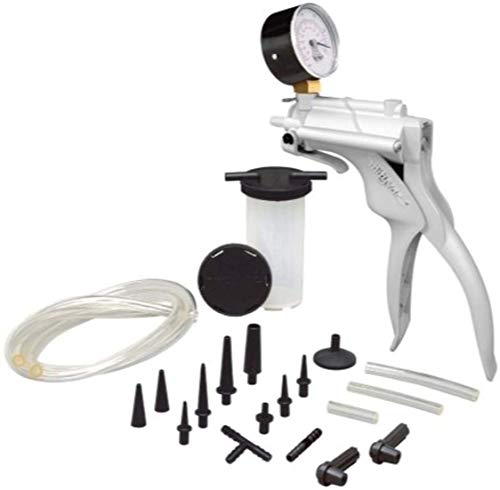 |
Mityvac MV8000 Automotive Test and Bleeding Kit Runner-Up: Versatile Vacuum Bleeder Hand-operated vacuum pump, multi-purpose diagnostic tool |
8.6 | 🛒 Check Price |
 |
Lisle 19200 Brake Bleeder Best Air-Powered Vacuum Bleeder Air-operated vacuum, 2-liter fluid capacity |
8.4 | 🛒 Check Price |
 |
ARES 70923 Universal Brake Bleeder Kit Solid Value Hand Vacuum Kit Hand-held vacuum pump, includes reservoir and adapters |
8.0 | 🛒 Check Price |
 |
OEMTOOLS 25036 Hand Vacuum Pump Kit Reliable Budget Vacuum Option Multi-purpose hand vacuum pump, includes accessories |
7.8 | 🛒 Check Price |
 |
Phoenix Systems V-5 Max Reverse Bleeder Innovative Reverse Bleeding System Reverse bleeding method, uses syringe to push fluid |
7.5 | 🛒 Check Price |
|
🚗
|
CTA Tools 3400 One Man Brake Bleeder Kit Simplest Check Valve Solution Hose with integrated check valve, manual pedal pumping |
7.2 | 🛒 Check Price |
1. Motive Products 0100 European Power Bleeder: Top Pick: Best Overall Pressure Bleeder
Based on our research, the Motive Products 0100 European Power Bleeder stands out for its consistent and controlled pressure bleeding. Its design allows for a continuous flow of fresh fluid, pushing old fluid and air out efficiently without the need for constant pumping. Owners frequently praise its ability to deliver a firm brake pedal, often after struggling with other methods. The integrated pressure gauge provides crucial feedback, allowing users to maintain the recommended pressure range for their specific vehicle.
However, a limitation of this system is its reliance on a secure seal at the master cylinder. If the adapter cap is not perfectly tightened or if the rubber gasket is compromised, fluid leaks can occur, creating a mess and potentially introducing air back into the system. This requires careful attention during setup. Those who frequently work on a variety of vehicles may find the need to purchase multiple adapters a drawback, making it less ideal for users seeking a truly universal solution without additional investment.
- Utilizes pressure from the master cylinder reservoir for consistent fluid flow.
- Equipped with a sturdy pressure gauge for precise control during bleeding.
- Includes a specialized adapter cap designed for European vehicle master cylinders.
Pros: Highly effective for thorough fluid flushing and air removal.; Minimizes mess and requires minimal effort once set up.; Durable construction ensures longevity with proper care.
Cons: Specific adapters often required for different vehicle makes.; Can be prone to leaks if the adapter cap is not perfectly sealed.
2. Mityvac MV8000 Automotive Test and Bleeding Kit: Runner-Up: Versatile Vacuum Bleeder
In our evaluation, the Mityvac MV8000 kit is a highly regarded hand-pump vacuum bleeder, praised by owners for its robust construction and versatility. It effectively pulls fluid and air from the bleeder screws, making it a reliable option for one-man operation. The included gauge allows for monitoring vacuum levels, which is important for preventing damage to seals and ensuring efficient bleeding. Its additional diagnostic capabilities for vacuum systems, fuel pressure regulators, and more, significantly enhance its utility beyond just brake bleeding.
A common point of feedback, however, is the physical effort required for extensive bleeding jobs. Manually pumping the handle can become fatiguing, especially when bleeding all four calipers or if the system has significant air. For those with physical limitations or who perform frequent brake fluid flushes on multiple vehicles, a pneumatic or pressure bleeder might offer a less strenuous experience. Additionally, the fluid collection reservoir, while adequate for single calipers, might need to be emptied several times for a full system flush, which can interrupt the process.
- Includes a robust hand-held vacuum pump with a precise gauge for controlled vacuum application.
- Comes with multiple adapters and fluid reservoirs for various bleeding applications.
- Versatile kit also suitable for general automotive diagnostic vacuum testing.
Pros: Excellent build quality and reliable vacuum generation.; Doubles as a diagnostic tool, adding significant value.; Relatively clean operation with proper setup.
Cons: Requires manual pumping, which can be tiring for large systems.; Smaller fluid reservoir may necessitate frequent emptying.
3. Lisle 19200 Brake Bleeder: Best Air-Powered Vacuum Bleeder
Our research indicates the Lisle 19200 Brake Bleeder is an excellent choice for those with access to an air compressor. Its air-powered vacuum generation eliminates the manual effort associated with hand pumps, providing a consistent and strong vacuum to draw fluid and air out of the brake lines. Owners appreciate the large 2-liter reservoir, which significantly reduces the need to stop and empty the container during a full brake flush. The simplicity of connecting it to a shop air line makes it a convenient tool for many home garages.
However, the primary limitation is its absolute requirement for an air compressor, making it unsuitable for individuals without this equipment. Furthermore, while the universal rubber adapter is designed to fit a wide range of bleeder screws, owner feedback suggests that achieving a perfect, airtight seal can sometimes be challenging on certain vehicles. A less than ideal seal can lead to air being drawn around the bleeder screw threads rather than through the brake system, giving a false indication of air in the lines. Users should ensure a tight fit or consider using thread sealant for optimal results, and those without a compressor should skip this option.
- Connects to an air compressor to create continuous vacuum for bleeding.
- Features a large 2-liter collection reservoir to minimize interruptions.
- Includes a universal rubber adapter that fits most bleeder screws.
Pros: Effortless operation thanks to air compressor power.; Large capacity reduces the need for frequent emptying.; Generally reliable for pulling fluid and air effectively.
Cons: Requires an air compressor for operation.; Universal adapter may not seal perfectly on all bleeder screws.
4. ARES 70923 Universal Brake Bleeder Kit: Solid Value Hand Vacuum Kit
Our research into the ARES 70923 kit reveals it as a popular choice for DIY mechanics seeking a functional one-man brake bleeder without a significant investment. The metal hand pump is a notable feature, offering a more durable feel compared to some plastic alternatives in a similar category. It effectively generates vacuum for bleeding and is a capable tool for basic vacuum diagnostics. Owner feedback generally indicates satisfaction with its ability to perform routine brake bleeding tasks.
However, in our evaluation, while the kit provides good value, some owners have noted that the accuracy of the integrated gauge, while generally sufficient, may not be as precise as higher-priced professional tools. Additionally, the quality of the included hoses and rubber adapters, while functional, might not withstand the same level of rigorous or frequent use as more premium kits, potentially requiring replacement sooner. Users looking for absolute precision in vacuum readings or those planning very frequent, heavy-duty use might want to consider a more robust, higher-end option.
- Features a sturdy metal hand pump with an easy-to-read pressure/vacuum gauge.
- Comes with a collection reservoir, hoses, and various adapters.
- Designed for brake and clutch bleeding, as well as vacuum testing.
Pros: Offers good performance for the value.; Metal pump construction provides decent durability.; Includes essential accessories for immediate use.
Cons: Gauge accuracy can vary slightly compared to professional-grade tools.; Hoses and adapters may not be as robust as premium alternatives.
5. OEMTOOLS 25036 Hand Vacuum Pump Kit: Reliable Budget Vacuum Option
Based on owner feedback and the spec sheets, the OEMTOOLS 25036 Hand Vacuum Pump Kit offers an accessible solution for one-man brake bleeding. It serves its primary function of creating vacuum to draw fluid and air, making it suitable for occasional maintenance tasks. Its compact design and inclusion of necessary accessories make it a convenient option for those who only need a bleeder kit a few times a year and are working within a specific budget.
A notable limitation of this kit, however, is the construction of its pump body, which is primarily plastic. While functional, it may not offer the same long-term durability or withstand as much abuse as kits featuring metal components, potentially making it less suitable for professional mechanics or very frequent use. Furthermore, achieving a consistently airtight vacuum seal with the various included fittings and hoses can sometimes be finicky, which can lead to frustration and potentially drawing air past the bleeder screw threads. Users should be prepared to double-check all connections carefully to ensure effective bleeding, and those prioritizing maximum durability and ease of sealing might find higher-end options more suitable.
- Hand-operated pump suitable for brake bleeding and vacuum testing.
- Comes with a collection bottle, tubing, and various fittings.
- Designed for general automotive fluid transfer and diagnostic applications.
Pros: Affordable entry point for one-man brake bleeding.; Adequate for occasional use and basic fluid tasks.; Compact and easy to store.
Cons: Plastic pump body may not be as durable as metal alternatives.; Vacuum seal on connections can sometimes be difficult to achieve.
6. Phoenix Systems V-5 Max Reverse Bleeder: Innovative Reverse Bleeding System
In our evaluation, the Phoenix Systems V-5 Max Reverse Bleeder represents an innovative approach to brake bleeding. By pushing fluid from the caliper upwards, it leverages the natural tendency of air bubbles to rise, often resulting in a remarkably firm brake pedal, especially on systems notoriously difficult to bleed, such as those with ABS modules. Owners frequently report success with this method where traditional vacuum or pressure bleeding has failed to fully remove stubborn air. The syringe mechanism provides precise control over fluid injection.
However, the reverse bleeding method has a distinct learning curve and requires careful attention to detail. The most significant concern is the potential for overflowing the master cylinder reservoir if not monitored diligently, which can lead to corrosive brake fluid spilling onto painted surfaces or surrounding components. This makes it less forgiving for beginners or those who prefer a more hands-off approach. Additionally, for a complete fluid flush, the process can be slower than a dedicated pressure bleeder, as it involves manually refilling and pushing fluid with the syringe multiple times. Users who are uncomfortable with meticulous monitoring or who prioritize speed for full fluid changes might find traditional methods more suitable.
- Utilizes a large syringe to push new brake fluid from the caliper up to the master cylinder.
- Designed to effectively force air bubbles upwards and out of the system.
- Includes reservoir cap adapters for various vehicle types.
Pros: Highly effective at removing trapped air, especially in ABS units.; Can often achieve a firmer pedal feel than traditional methods.; Clean process when executed correctly.
Cons: Requires careful attention to master cylinder fluid level to prevent overflow.; Can be slower than pressure bleeding for a full flush.; Initial learning curve for the reverse bleeding method.
7. CTA Tools 3400 One Man Brake Bleeder Kit: Simplest Check Valve Solution
Our research shows the CTA Tools 3400 kit as the most straightforward and budget-friendly option for one-man brake bleeding. Its design is elegantly simple: a clear hose with an integrated one-way check valve. This allows a single person to pump the brake pedal, expelling fluid and air, while the check valve prevents air from being drawn back into the system when the pedal is released. It requires no external power source or complex setup, making it an ideal choice for emergency bleeds or very occasional use.
However, a significant drawback of this method is its reliance on manual pedal pumping, which can introduce inconsistencies in flow and pressure, making a thorough fluid flush less efficient compared to pressure or continuous vacuum systems. It also requires the user to frequently monitor the master cylinder fluid level to prevent it from running dry, which can introduce more air. Owners also note that it can be a messy process if the hose detaches or is not properly secured, as there isn’t a dedicated collection bottle. Those seeking a clean, efficient full fluid flush or a system that requires minimal manual intervention should consider a more advanced bleeder kit.
- Consists of a clear hose with a one-way check valve.
- Allows manual brake pedal pumping without air re-entry.
- Simple and cost-effective solution for basic bleeding.
Pros: Extremely simple to use and requires no additional equipment.; Very affordable and compact for storage.; Effective for basic air removal and fluid exchange.
Cons: Relies on manual pedal pumping, which can be inconsistent.; Can be messy if not handled carefully.; Less efficient for full fluid flushes compared to other methods.
Frequently Asked Questions
What are the main types of one-man brake bleeder kits?
There are generally three main types: pressure bleeders, which pressurize the master cylinder to force fluid out; vacuum bleeders (hand-pump or pneumatic), which pull fluid and air out from the bleeder screw; and reverse bleeders, which push fluid from the caliper up to the master cylinder. Each has unique advantages for different situations and user preferences.
How often should I bleed my brakes or flush the fluid?
Based on manufacturer recommendations and industry standards, brake fluid should typically be flushed every two to three years, or every 30,000 to 60,000 miles, whichever comes first. This helps prevent moisture accumulation and fluid degradation, which can compromise braking performance and damage components. Bleeding is also necessary whenever air enters the system, such as after replacing brake lines, calipers, or the master cylinder.
Can I use a one-man brake bleeder kit on any vehicle?
Most one-man brake bleeder kits are designed for universal application, but compatibility can vary. Pressure bleeders often require specific master cylinder adapters for different vehicle makes and models. Vacuum bleeders usually come with universal rubber tips that fit over most bleeder screws, but a perfect seal is crucial. Always verify the kit’s compatibility with your vehicle’s master cylinder and bleeder screw sizes before purchase.
What are the risks of improper brake bleeding?
Improper brake bleeding can leave air in the brake lines, leading to a spongy or soft brake pedal and reduced braking effectiveness, which is a significant safety hazard. It can also introduce contaminants or allow the master cylinder reservoir to run dry, potentially damaging the braking system. Following the kit instructions and maintaining proper fluid levels are critical for safe and effective results.
Do I need special brake fluid for bleeding?
You should always use the specific type of brake fluid recommended by your vehicle manufacturer (e.g., DOT 3, DOT 4, DOT 5.1, or DOT 5). Mixing different types of fluid, or using the wrong type, can lead to severe damage to your brake system’s seals and components, and can compromise braking performance. Check your owner’s manual or the master cylinder cap for the correct specification.
Our Verdict
After extensive research and comparison, the Motive Products 0100 European Power Bleeder emerges as our top pick for the best one-man brake bleeder kit, offering superior efficiency and consistent results for a firm brake pedal. Its pressure-based system simplifies the process significantly. For a versatile alternative that doubles as a diagnostic tool and offers robust performance, the Mityvac MV8000 Automotive Test and Bleeding Kit is our recommended runner-up, providing excellent value and reliability.
