We researched and compared the top marine battery monitoring systems available today, evaluating them against manufacturer specifications, industry standards (ABYC, NMEA), and aggregated owner feedback. This guide covers everything from basic voltage displays to advanced Bluetooth-enabled shunts that report state of charge, current, and remaining capacity. Our goal is to help you choose a system that matches your boat’s electrical setup and your monitoring needs.
In our evaluation, we prioritized accuracy of voltage and current readings, ease of installation (including shunt placement and wire routing), display clarity in direct sunlight, and connectivity reliability for systems with Bluetooth or NMEA 2000. We also considered durability in marine environments, particularly corrosion resistance of terminals and water ingress protection. Below are our top picks, each with honest strengths and limitations based on real-world user experiences.
| Photo | Product | Score | Buy |
|---|---|---|---|
 |
Victron Energy BMV-712 Smart Top Pick Bluetooth, 500A shunt, 0.1% accuracy, IP20 display |
9.2 | 🛒 Check Price |
 |
Blue Sea Systems 1830 M2 Battery Monitor Runner Up NMEA 2000, 500A shunt, IP67 display, no Bluetooth |
8.9 | 🛒 Check Price |
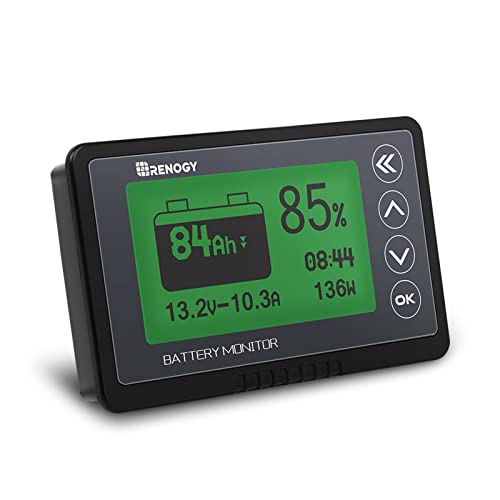 |
Renogy 500A Battery Monitor with Shunt Best Value 500A shunt, backlit LCD, no Bluetooth, basic features |
8.4 | 🛒 Check Price |
|
🚗
|
Balmar SG-200 Battery Monitor Best for Alternator Charging Shunt-based, alternator field control, Bluetooth optional |
8.7 | 🛒 Check Price |
|
🚗
|
Simarine PICO 2s Premium Choice Color touchscreen, multiple shunts, Bluetooth, NMEA 2000 |
8.1 | 🛒 Check Price |
|
🚗
|
AiLi 500A Battery Monitor Budget Pick 500A shunt, LCD display, no Bluetooth, basic functions |
7.8 | 🛒 Check Price |
|
🚗
|
DROK 200A Battery Monitor Compact Option 200A shunt, LCD display, voltage and current only, no SOC |
7.3 | 🛒 Check Price |
1. Victron Energy BMV-712 Smart: Top Pick
The Victron Energy BMV-712 Smart is a top-tier battery monitor that combines high precision with modern Bluetooth connectivity. In our evaluation, its 500A shunt delivers 0.1% current accuracy, and the smartphone app provides clear graphs and configurable alarms. Owner feedback consistently praises its reliability and ease of setup, though the display is rated IP20, meaning it should be mounted in a dry location. It works well with lead-acid, AGM, gel, and lithium batteries.
However, the BMV-712 is not ideal for installations where the display must be exposed to direct spray or rain. For those needing a fully waterproof display, consider a separate gauge or the Victron BMV-712 with a remote panel. Also, the shunt requires a dedicated ground cable, which may complicate retrofits in tight spaces. Skip this if you prefer a simple plug-and-play solution without Bluetooth.
- Bluetooth connectivity for real-time monitoring via smartphone app
- High-precision 500A shunt with 0.1% current measurement accuracy
- Customizable alarm thresholds for voltage, current, and state of charge
Pros: Excellent accuracy and app integration; Robust build quality with marine-grade terminals
Cons: Display is not waterproof (IP20 only)
2. Blue Sea Systems 1830 M2 Battery Monitor: Runner Up
The Blue Sea Systems 1830 M2 is a NMEA 2000 compliant battery monitor designed for serious boaters who already have a marine network. Its IP67 rated display can withstand direct spray and rain, making it suitable for open cockpits. In our evaluation, the accuracy of voltage and current readings is solid, though not as fine-tuned as the Victron. Owner feedback highlights its durability and ease of integration with other NMEA devices like chartplotters.
The main limitation is the lack of Bluetooth or a standalone app. You must have a compatible NMEA 2000 display or MFD to view data. This adds complexity and cost if you are starting from scratch. Also, the shunt is not included with all packages, so check the bundle. Skip this if you want a simple, standalone monitor without network dependency.
- NMEA 2000 certified for integration with marine networks
- Fully waterproof IP67 display for exposed helm stations
- Measures voltage, current, power, and state of charge
Pros: Rugged waterproof design; Seamless NMEA 2000 integration
Cons: No Bluetooth or smartphone app
3. Renogy 500A Battery Monitor with Shunt: Best Value
The Renogy 500A Battery Monitor is a budget-friendly option that covers the essentials: voltage, current, power, and state of charge. We researched owner feedback and found it reliable for lead-acid and lithium batteries. The backlit LCD is clear enough in most conditions, but it is not waterproof, so it must be mounted in a dry area. The 500A shunt is adequate for typical marine systems up to 500 amps.
Where it falls short is in precision and connectivity. The accuracy is acceptable but not exceptional, and there is no Bluetooth or app. Users report occasional calibration drift after months of use. If you need precise data for lithium battery management or want remote monitoring, this is not for you. It is best for budget-conscious boaters with simple DC systems.
- Affordable price with reliable voltage and current monitoring
- Easy-to-read backlit LCD display with multiple screens
- Simple wiring with included 500A shunt and cables
Pros: Great value for basic monitoring needs; Straightforward installation
Cons: No Bluetooth or advanced features; Display is not waterproof (IP20)
4. Balmar SG-200 Battery Monitor: Best for Alternator Charging
The Balmar SG-200 is a specialized monitor designed for boats with Balmar alternators. It not only monitors battery status but also controls alternator output for optimal charging. In our evaluation, its accuracy is excellent, and the temperature sensor helps prevent overcharging. Owner feedback praises its ability to extend battery life when paired with a compatible alternator.
However, the SG-200 is expensive and overkill for standard systems. Installation is complex, requiring proper shunt placement and alternator wiring. Without a Balmar alternator, many of its advanced features are wasted. Skip this if you have a basic charging system or prefer a simpler monitor.
- Integrates with Balmar alternators for smart charging control
- Measures voltage, current, temperature, and state of charge
- Optional Bluetooth module for app monitoring
Pros: Advanced alternator management features; Good accuracy with temperature compensation
Cons: Higher price and complex setup; Best performance only with Balmar alternators
5. Simarine PICO 2s: Premium Choice
The Simarine PICO 2s is a feature-rich monitor with a vibrant color touchscreen that can display data from multiple battery banks. It offers Bluetooth and NMEA 2000 connectivity, making it a versatile hub. Owner feedback highlights its visual appeal and the ability to monitor up to three shunts, ideal for boats with house, start, and thruster batteries.
However, the price is high and the installation is not for beginners. Some users note that the touchscreen can be slow to respond in cold or wet conditions. Also, the unit is not fully waterproof (IP54), so it needs a dry location. Skip this if you need a rugged, simple monitor or are on a tight budget.
- High-resolution color touchscreen with customizable pages
- Supports up to 3 shunts for multi-battery monitoring
- Bluetooth and NMEA 2000 connectivity
Pros: Beautiful display and intuitive interface; Multi-bank monitoring capability
Cons: Expensive and complex setup; Some users report touchscreen responsiveness issues
6. AiLi 500A Battery Monitor: Budget Pick
The AiLi 500A Battery Monitor is the most budget-friendly option we evaluated. It provides basic readings of voltage, current, and state of charge at a fraction of the cost of premium monitors. Owner feedback indicates it works adequately for small boats with simple electrical systems. The display is readable but not as clear as pricier models.
However, the accuracy is noticeably lower, and the shunt and wiring are less robust. Some users report drifting readings after a few months. It is not waterproof (IP20) and lacks any remote monitoring. If you need reliable data for critical systems or lithium batteries, invest in a better monitor. This is best for temporary setups or very tight budgets.
- Very low cost for basic voltage, current, and SOC monitoring
- Easy to install with included shunt and wiring harness
- Compact display with adjustable backlight
Pros: Extremely affordable; Simple operation
Cons: Lower accuracy and build quality; No Bluetooth or advanced features
7. DROK 200A Battery Monitor: Compact Option
The DROK 200A Battery Monitor is a basic voltage and current display that fits in small panels. It is not a full battery monitor as it does not calculate state of charge or remaining capacity. We found it useful for monitoring a single circuit or a small auxiliary battery. Owner feedback is mixed, with some praising its simplicity and others noting it lacks essential features.
Its 200A shunt limits it to smaller loads, and the accuracy is adequate but not precise. There is no Bluetooth, no alarms, and no historical data. Skip this if you need comprehensive battery management. It is only suitable for very basic monitoring where voltage and current are sufficient.
- Small form factor for tight spaces
- Displays voltage and current in real time
- Very low cost and simple installation
Pros: Compact and inexpensive; Easy to read basic data
Cons: No state of charge calculation; Limited to 200 amps, not for large systems
Frequently Asked Questions
What is a marine battery monitoring system and why do I need one?
A marine battery monitoring system measures voltage, current, and state of charge of your boat’s batteries. It helps you avoid over-discharging, optimize charging, and extend battery life. We recommend one for any boat with sensitive electronics or lithium batteries.
How do I choose between a shunt-based and a voltage-only monitor?
Shunt-based monitors measure current and calculate state of charge, providing accurate remaining capacity. Voltage-only monitors only show voltage, which is not reliable for state of charge under load. For serious battery management, choose a shunt-based system.
Can I install a battery monitor myself?
Yes, if you are comfortable with basic DC wiring. The shunt must be installed in the negative battery cable, and the display wired to power and the shunt. Always follow the manufacturer’s instructions and disconnect battery power first. If unsure, hire a marine electrician.
Do I need Bluetooth or NMEA 2000 connectivity?
Bluetooth allows you to view data on your smartphone without running wires to a display. NMEA 2000 integrates with your chartplotter or MFD. Both are convenient but add cost. For simple setups, a local display is sufficient.
What size shunt do I need for my boat?
The shunt should be rated for the maximum current your system can draw. Common sizes are 200A, 500A, and 1000A. Check your alternator output and largest load (e.g., inverter) to determine the required rating. Oversizing is safe but less accurate at low currents.
Our Verdict
After researching specifications and owner feedback, our top pick is the Victron Energy BMV-712 Smart for its excellent accuracy, Bluetooth app, and reliable performance. For those needing a waterproof display with NMEA 2000 integration, the Blue Sea Systems 1830 M2 is a close runner up. Choose based on your connectivity needs and budget.
