An LS swap eats fuel differently than the carbureted engine it replaced. These engines run high-pressure electronic fuel injection, usually wanting 58 PSI at the rail, and a tired stock low-pressure pump simply cannot keep up once you add a cam, headers, or boost. Picking the right in-tank fuel pump is the difference between a swap that idles clean and pulls hard, and one that leans out at the top of third gear and starves under sustained load.
We focused on in-tank pumps because they run quieter, stay cooler, and self-prime far better than an inline pump bolted to a frame rail. Below are seven pumps that LS builders actually trust, ranked by flow capacity, EFI pressure handling, install fit, and long-term reliability. Whether you are feeding a mild 5.3 daily driver or a forced-induction LS3, there is a pump here sized for your power target.
| Photo | Product | Score | Buy |
|---|---|---|---|
 |
Walbro GSS342 255 LPH High Pressure In-Tank Fuel Pump Best Overall 255 LPH at 43 PSI, high-pressure EFI design, supports roughly 500 to 600 naturally aspirated horsepower |
9.5 | 🛒 Check Price |
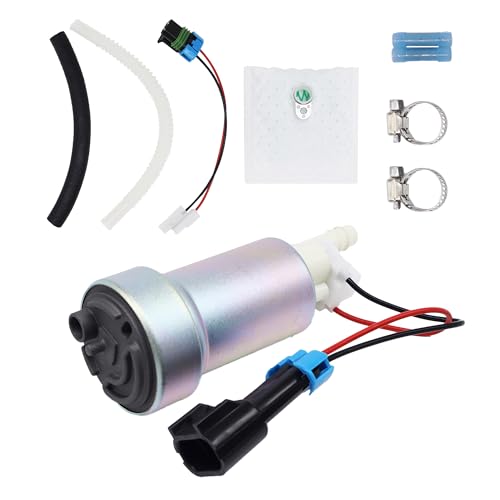 |
Walbro F90000267 450 LPH E85 In-Tank Fuel Pump Best for Big Power 450 LPH flow, E85 compatible, supports roughly 900 to 1000 horsepower on pump gas |
9.3 | 🛒 Check Price |
 |
AEM 50-1200 320 LPH High Flow In-Tank Fuel Pump Best Flow Per Dollar 320 LPH at 40 PSI, high-pressure E85 safe, supports roughly 700 horsepower naturally aspirated |
9.1 | 🛒 Check Price |
 |
DeatschWerks DW300 340 LPH In-Tank Fuel Pump Best Quiet Operation 340 LPH at 40 PSI, E85 compatible, supports roughly 700 horsepower with a quiet motor |
9.0 | 🛒 Check Price |
|
TI Automotive GSS342 255 LPH OE Replacement Fuel Pump Best OE Quality 255 LPH at 43 PSI, OE manufacturer build, supports roughly 500 horsepower naturally aspirated |
8.8 | 🛒 Check Price |
 |
Bosch 69100 In-Tank Electric Fuel Pump Best Reliability High-pressure EFI in-tank design, OE Bosch quality, supports a mild LS swap fuel demand |
8.5 | 🛒 Check Price |
 |
Holley 12-920 255 LPH HydraMat-Ready In-Tank Fuel Pump Best for Fuel Pickup 255 LPH at 43 PSI, EFI-rated, designed to pair with Holley in-tank pickup and module systems |
8.2 | 🛒 Check Price |
1. Walbro GSS342 255 LPH High Pressure In-Tank Fuel Pump: Best Overall
The Walbro GSS342 is the default answer for a reason. It is a true high-pressure pump, so it actually maintains the 58 PSI an LS fuel rail expects rather than the lower carb-style pressure many universal pumps are rated at. For a naturally aspirated 5.3, 6.0, or LS3 making up to roughly 500 to 600 horsepower, this pump feeds the rail without breaking a sweat, and the universal 39mm body means it slots into most factory hangers, aftermarket sumps, and weld-in tanks with minimal fabrication.
The honest weakness is noise and pickup. Until the pump is fully submerged it makes an audible whine that some builders find annoying in a quiet street car, and because it is a high-output pump it can momentarily uncover and lean out in a shallow tank during hard cornering or low fuel. Pair it with a proper sump or surge tank and that concern disappears, but a straight drop-in to a baffle-free tank can surprise you. For the vast majority of LS swaps, it is still the safest first choice.
- 255 LPH flow rated for high-pressure EFI, ideal for the 58 PSI an LS rail wants
- Universal 39mm in-tank body that drops into most factory hanger and aftermarket sump setups
- Includes the install kit with strainer, wiring, and hose for a clean retrofit
Pros: Proven LS-swap reliability with a huge install base and parts support; Holds 58 PSI without sagging well into the 500 horsepower range; Drops into countless tanks thanks to the standard 39mm form factor
Cons: Louder than a quiet factory pump until it is fully submerged; May need a deep sump or surge tank to avoid uncovering under hard cornering
2. Walbro F90000267 450 LPH E85 In-Tank Fuel Pump: Best for Big Power
When your LS swap grows a turbo or a blower, the 255 LPH pumps run out of breath, and the F90000267 is where serious builders go next. Rated at 450 LPH and fully E85 compatible, this pump supports roughly 900 to 1000 horsepower on pump gas and keeps the rail pressurized even as boost demands climb. For flex-fuel and ethanol setups it is one of the few pumps that will not corrode internally on a steady diet of E85, which makes it a genuine long-term solution rather than a part you replace every season.
The trade-off is that it is simply too much pump for a stock-cammed 5.3 daily. It draws significant current, so you must upgrade the pump wiring with a relay and heavier gauge feed or you will brown out the pump and risk burning the factory wiring. It is also loud at idle. If your build is under about 600 horsepower, you are paying for capacity and noise you will never use, but for a boosted or E85 LS this pump earns its place.
- 450 LPH of flow for boosted or high-horsepower LS builds
- Fully E85 compatible internals for flex-fuel and ethanol setups
- High-pressure design holds rail pressure deep into the boost range
Pros: Massive headroom for turbo and supercharged LS engines; Handles E85 without the corrosion issues that kill lesser pumps; Single pump can replace a dual-pump setup on many builds
Cons: Overkill and unnecessarily loud for a mild naturally aspirated swap; Needs an upgraded high-amperage wiring and relay to feed it properly
3. AEM 50-1200 320 LPH High Flow In-Tank Fuel Pump: Best Flow Per Dollar
The AEM 50-1200 sits in the sweet spot between the everyday 255 LPH pump and the big 450 LPH units. At 320 LPH it gives you real headroom, supporting roughly 700 naturally aspirated horsepower, while keeping a 39mm body that drops into the same tanks. It is also E85 safe from the factory, so if you ever convert your LS to ethanol you are not shopping for a new pump. For a builder who knows the engine will grow but is not chasing four-digit power yet, this is the smart middle path.
The catch is the universal nature of the kit. The hardware is generic, so depending on your hanger or sump you may need to trim the strainer sock clearance or adapt the outlet, and a clean factory-style fit is not always guaranteed. It is also clearly not a boost pump on its own once you cross into serious forced induction territory. Within its window, though, it offers some of the best flow per effort of any pump on this list.
- 320 LPH flow, a meaningful step above 255 LPH pumps for headroom
- Ethanol and E85 safe internals for flex-fuel LS builds
- Universal install kit fits most 39mm tank applications
Pros: More flow than a 255 pump for a similar footprint and effort; E85 safe out of the box, unlike many standard pumps; Strong mid-range value for a mildly built LS that may grow later
Cons: Install kit fitment is universal, so some tanks need minor adapting; Not enough alone for serious boost above the 700 horsepower mark
4. DeatschWerks DW300 340 LPH In-Tank Fuel Pump: Best Quiet Operation
DeatschWerks built the DW300 to address the single most common Walbro complaint, which is noise. This pump flows 340 LPH, slightly more than the AEM, but does it with a quieter motor that you will appreciate in a clean street build where you actually hear the fuel pump at idle. It is E85 compatible and holds high pressure well, and DeatschWerks offers application-specific install kits that take the guesswork out of fitting it to common hangers, which makes the install cleaner than a generic universal kit.
The honest downside is that the application-specific approach means you have to match the right kit to your tank, and for an LS swap into an unusual chassis you may still end up with the universal version and some adapting. Its top-end flow also tapers off sooner than a true 450 LPH pump, so it is not your choice for a boosted monster. For a refined naturally aspirated LS that values low noise as much as flow, though, it is hard to beat.
- 340 LPH flow with notably quieter operation than a Walbro 255
- E85 and pump gas compatible for flexible fuel choices
- Application-specific install kits available for cleaner LS retrofits
Pros: Noticeably quieter at idle, ideal for a refined street swap; Strong 340 LPH flow with good high-pressure holding; Quality install hardware reduces fabrication headaches
Cons: Application-specific kits add a step when sourcing the right fit; Top-end flow tapers sooner than a dedicated 450 LPH pump
5. TI Automotive GSS342 255 LPH OE Replacement Fuel Pump: Best OE Quality
TI Automotive is the manufacturer that actually produces many of the pumps sold under other names, including the well-known 255 LPH design. Buying the TI-branded GSS342 gets you genuine OE-grade build quality and the consistency that comes from a factory supplier rather than a repackaged import. At 255 LPH it feeds a mild to moderate LS swap up to roughly 500 horsepower, holds proper EFI rail pressure, and drops into the same 39mm tanks as the rest of the 255 class.
The limitation is that you are buying quality, not capacity. It flows the same as any other 255 pump, so if you need more headroom you should step up to a 320 or 340 LPH unit instead. The bigger real-world risk is the marketplace itself, because counterfeit 255 pumps are common, so you must buy from a reputable seller to actually get the genuine TI article. Do that, and you have a dependable pump with the best pedigree in its flow class.
- Built by the OE supplier behind many factory and Walbro pumps
- 255 LPH high-pressure flow tuned for EFI rail pressure
- 39mm universal body for broad LS tank compatibility
Pros: Genuine OE-grade build quality and consistency; Direct cross to the popular 255 LPH form factor; Reliable choice for a mild to moderate LS swap
Cons: No real flow advantage over a standard 255 pump; Counterfeit listings exist, so buy from trusted sellers
6. Bosch 69100 In-Tank Electric Fuel Pump: Best Reliability
If your LS swap is a stock or near-stock 5.3 or 6.0 that you intend to drive every day, raw flow numbers matter less than the pump simply never failing. Bosch in-tank pumps are the OE benchmark for that, with the kind of quiet, smooth, long-life operation that comes from designing pumps for millions of factory vehicles. The 69100 holds the high pressure an EFI rail needs and disappears into the background the way a good fuel pump should, which is exactly what you want in a reliable swap.
The clear ceiling here is headroom. This is a replacement-grade pump, not a performance pump, so it has little spare capacity once you add a cam, a blower, or serious power, and you will quickly outgrow it on a built engine. Fitment also varies, so you must confirm the body and inlet dimensions against your specific hanger before ordering. For a clean, low-power, daily LS swap that values dependability over numbers, it is a quietly excellent choice.
- Bosch OE engineering known for long service life
- High-pressure in-tank design suited to EFI rail pressure
- Quiet, smooth operation typical of factory-style pumps
Pros: Outstanding long-term reliability from a trusted OE brand; Quiet and refined for a daily-driven LS swap; Easy to source and widely cross-referenced
Cons: Limited flow headroom for a built or boosted engine; Fitment requires checking dimensions against your hanger
7. Holley 12-920 255 LPH HydraMat-Ready In-Tank Fuel Pump: Best for Fuel Pickup
The Holley 12-920 is a 255 LPH EFI-rated pump that makes the most sense when you are already building inside the Holley fuel ecosystem. Its real strength is integration, because it is designed to work with Holley in-tank modules and pickups, and when paired with a HydraMat-style pickup it dramatically reduces the fuel starvation that plagues high-output pumps in shallow or unbaffled tanks during hard cornering. For an LS swap that sees autocross or track time, that starvation protection is worth as much as the flow figure.
The honest caveat is that the pump alone is just another 255 LPH unit, so the value is unlocked only when you commit to the surrounding Holley module and pickup hardware. Buy it as a standalone drop-in and you gain nothing over cheaper 255 pumps. It also shares the same flow ceiling as the rest of its class, so it is not a big-power solution. As the heart of a properly built Holley in-tank system, though, it solves the pickup problem better than a bare pump ever could.
- 255 LPH EFI-rated flow for a typical LS swap fuel demand
- Designed to integrate with Holley in-tank modules and pickups
- Pairs well with a HydraMat to fight fuel starvation on cornering
Pros: Integrates cleanly into the Holley EFI ecosystem; Strong starvation protection when paired with a pickup mat; Solid 255 LPH flow for street and mild track use
Cons: Best value comes only inside the broader Holley module system; Same 255 flow ceiling as other pumps in this class
Frequently Asked Questions
What fuel pump flow rating do I need for an LS swap?
For a stock to mildly modified naturally aspirated LS making up to roughly 500 horsepower, a high-pressure 255 LPH in-tank pump like the Walbro GSS342 is plenty. If you are running a healthy cam, headers, and head work pushing toward 600 to 700 horsepower, step up to a 320 or 340 LPH pump such as the AEM 50-1200 or DeatschWerks DW300. For any boosted or E85 build chasing 900 horsepower or more, you want a 450 LPH pump like the Walbro F90000267. Always size for your final power goal, not where the engine is today, because swapping a pump later means dropping the tank again.
Why choose an in-tank pump instead of an inline pump for an LS swap?
In-tank pumps run cooler because the surrounding fuel acts as a heat sink, they are much quieter since the fuel and tank muffle the motor, and they self-prime reliably because they are always sitting in the fuel they need to pull. An inline pump mounted on a frame rail has to suck fuel from the tank, which makes it more prone to cavitation, vapor lock, and noise, and it usually needs a gravity-fed or sumped tank to feed it properly. For a clean, quiet, dependable EFI LS swap, an in-tank pump is almost always the better engineering choice.
Will a 255 LPH pump hold the 58 PSI my LS fuel rail needs?
Yes, as long as you buy a genuine high-pressure pump rather than a carb-style universal unit rated only at lower pressure. The Walbro and TI Automotive 255 LPH pumps are specifically designed for high-pressure EFI and will maintain 58 PSI at the rail throughout their rated flow range. Just remember that a pump’s flow rating drops as pressure rises, so a 255 LPH pump flows less than 255 liters per hour once it is working against 58 PSI. That is why builders chasing big power move up to higher-rated pumps rather than running a 255 at its limit.
Do I need to upgrade my wiring when installing a high-flow fuel pump?
For a basic 255 LPH pump the factory wiring is often adequate, though adding a dedicated relay and fresh ground is cheap insurance. Once you move to a 320 LPH pump or larger, and especially with a 450 LPH unit, upgraded wiring becomes mandatory. These pumps draw serious current, and feeding them through thin factory wires causes voltage drop that starves the pump, hurts flow, and can overheat or melt the original harness. Run a heavier gauge power feed through a relay triggered by the factory circuit, and add a solid ground, so the pump sees full battery voltage and delivers its rated flow.
Can these in-tank pumps run on E85 for my LS swap?
It depends on the specific pump. The Walbro F90000267, AEM 50-1200, and DeatschWerks DW300 all use ethanol-safe internals and are rated for E85, so they are the right choices for a flex-fuel or full ethanol LS. A standard Walbro GSS342 or TI Automotive 255 will run on E85 but is not officially rated for continuous ethanol use and can degrade over time. If E85 is in your plans now or later, buy an explicitly E85-compatible pump up front, because ethanol is harder on pump internals than gasoline and a non-rated pump will not last.
Our Verdict
For most LS swaps, the Walbro GSS342 255 LPH is the top pick because it reliably holds 58 PSI, drops into nearly any tank thanks to its universal 39mm body, and has the largest proven track record in the swap community for naturally aspirated builds up to roughly 500 to 600 horsepower. If your build is boosted, runs E85, or is chasing four-digit power, the Walbro F90000267 450 LPH is the runner up and the smarter long-term investment, giving you the flow and ethanol compatibility to feed a serious LS without a second pump. Size the pump for your final goal, upgrade the wiring to match, and your swap will never go hungry.
