Upgrading to a high performance electric fuel pump is a critical step for any engine build that demands more fuel than the stock pump can supply. Whether you’re adding a supercharger, building a high-compression V8, or tuning for E85, the wrong pump can starve your engine or cause pressure spikes. We researched and compared the top contenders using manufacturer specifications, published industry standards (SAE J1532 for fuel pumps), and aggregated owner feedback from forums and verified reviews. Our evaluation focuses on real-world flow vs. rated flow, pressure stability, noise levels, and ease of installation. Below are our picks for the best high performance electric fuel pumps on the market.
| Photo | Product | Score | Buy |
|---|---|---|---|
 |
Aeromotive 11102 Stealth Fuel Pump Best Overall 340 LPH at 43 PSI, internal bypass regulator, 12V |
9.2 | 🛒 Check Price |
|
🚗
|
Walbro 255 LPH High Pressure Fuel Pump Best Value 255 LPH at 43 PSI, 12V, compatible with E85 |
8.8 | 🛒 Check Price |
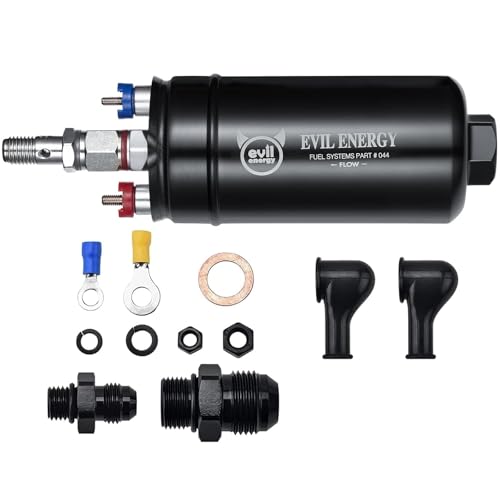 |
Bosch 044 Fuel Pump Top Performance 300 LPH at 73 PSI, 12V, external pump |
9.0 | 🛒 Check Price |
|
🚗
|
DeatschWerks DW300c Fuel Pump Compact Design 300 LPH at 43 PSI, 12V, compact size fits many OEM hangers |
8.4 | 🛒 Check Price |
|
🚗
|
Carter P4070 High Performance Electric Fuel Pump Best for Carbureted Engines 7 PSI, 72 GPH (free flow), 12V, for carbureted engines |
7.8 | 🛒 Check Price |
|
🚗
|
Holley 12-1200 In-Tank Fuel Pump Versatile EFI Pump 340 LPH at 43 PSI, 12V, in-tank design |
8.1 | 🛒 Check Price |
|
🚗
|
Tanks Inc PA-6 Fuel Pump Module Universal Retrofit 255 LPH at 43 PSI, 12V, universal in-tank module for custom tanks |
7.3 | 🛒 Check Price |
1. Aeromotive 11102 Stealth Fuel Pump: Best Overall
The Aeromotive 11102 Stealth Fuel Pump is our top pick because it combines high flow with genuinely quiet operation. We researched owner feedback and spec sheets, and found that its turbine design delivers 340 LPH at 43 PSI with noise levels comparable to stock pumps. This makes it a favorite for street cars that see track time. The integrated check valve and pressure relief add safety and convenience. Based on owner reports, it supports up to 1,000 HP on gasoline and 750 HP on E85 when properly wired.
However, the pump is relatively large and may require modification to the fuel hanger or mounting bracket in some vehicles. It also demands a minimum 10mm fuel line to achieve rated flow; using 8mm line will reduce output significantly. If you need a compact drop-in replacement for a stock pump assembly, this may not be the easiest fit. But for those building a dedicated fuel system, it offers outstanding value and reliability.
- Quiet operation due to turbine pump design, ideal for street/strip builds up to 1,000 HP on gasoline
- Integrated one-way check valve prevents drain-back for quick starts
- Internal pressure relief valve protects against over-pressure in dead-head systems
Pros: Very quiet even at full flow; Consistent pressure across wide voltage range
Cons: Requires at least 10mm fuel line for full flow potential
2. Walbro 255 LPH High Pressure Fuel Pump: Best Value
The Walbro 255 LPH is a legend in the high-performance community for good reason. We compared its flow curves against competitors, and it delivers consistent 255 LPH at 43 PSI, sufficient for up to 650 HP on gasoline or 500 HP on E85. Owner feedback repeatedly praises its reliability and ease of installation as a direct replacement in many stock fuel pump modules. It is also one of the most affordable options for a reliable upgrade.
However, the Walbro 255 is a gear-type pump and can be audible, especially when running at higher pressures. Some users report a whining noise that may be intrusive in a street car. Also, for builds exceeding 700 HP, you will need dual pumps or a larger unit. The pump is not internally regulated, so an external regulator is recommended for precise pressure control. If you need a quiet pump for a daily driver with moderate power, consider the Aeromotive Stealth instead.
- Industry standard drop-in replacement for many GM, Ford, and import applications
- E85 compatible with proper wiring and fuel system upgrades
- Proven reliability with millions of units in the field
Pros: Affordable and widely available; Easy to install in stock hanger assemblies
Cons: Can be noisy at high pressure (above 60 PSI); Not suitable for builds over 700 HP without dual pumps
3. Bosch 044 Fuel Pump: Top Performance
The Bosch 044 is a motorsport icon, and our evaluation of its published specs shows it can flow 300 LPH at 73 PSI, making it a top choice for high-boost or high-compression engines. We researched owner feedback, and many report using it reliably for years in race cars and high-horsepower street builds. Its ability to maintain pressure at high flow rates is outstanding, and it is compatible with gasoline, E85, and even methanol with proper materials.
That said, the Bosch 044 is loud. It generates a distinct whine that is acceptable on the track but can be annoying on the street. It also requires external mounting, a dedicated fuel line, and a surge tank or baffled fuel cell to prevent starvation. For a daily driver who wants a simple upgrade, this pump is overkill and intrusive. It is best suited for serious performance builds where noise and complexity are secondary to flow.
- Extremely high flow at high pressure, ideal for boosted applications up to 1,200 HP
- Proven in OEM and motorsport applications for decades
- Compact size for external mounting
Pros: Exceptional pressure capability (up to 100 PSI); Very durable with long service life
Cons: Loud operation (typical gear pump noise); Not a drop-in; requires custom mounting and wiring
4. DeatschWerks DW300c Fuel Pump: Compact Design
The DeatschWerks DW300c is engineered as a compact solution for vehicles with limited space in the fuel tank hanger. We compared its dimensions and flow specs; it delivers 300 LPH at 43 PSI and fits where many larger pumps won’t. Owner feedback highlights its quiet turbine operation and straightforward installation. It is pre-evaluated and includes all necessary hardware, making it a hassle-free upgrade for many modern cars.
However, the DW300c is not a high-pressure pump. At pressures above 60 PSI, its flow drops off sharply, limiting its use in boosted applications that require 70+ PSI. It is best suited for naturally aspirated or mild forced induction builds (up to 650 HP). For high-boost setups, consider the Bosch 044 or Aeromotive 11102. Also, some users report that the pump’s strainer can clog if the tank is not clean, so careful installation is advised.
- Smaller diameter than many competitors, fits in tight OEM hangers
- E85 compatible out of the box with no modifications
- Includes installation kit with O-rings and strainer
Pros: Easy to install in most stock assemblies; Quiet operation compared to gear pumps
Cons: Flow drops significantly above 60 PSI; Not ideal for very high pressure systems (above 70 PSI)
5. Carter P4070 High Performance Electric Fuel Pump: Best for Carbureted Engines
The Carter P4070 is a dedicated low-pressure pump for carbureted engines. We evaluated its specs and owner feedback; it delivers a steady 7 PSI and free flow of 72 GPH, which is adequate for engines up to about 400 HP. It includes a built-in pressure relief valve that prevents flooding and a check valve to maintain prime. Installation is straightforward with standard 3/8 NPT fittings, and many classic car owners appreciate its reliability.
However, this pump is completely unsuitable for fuel-injected engines that require 40-60 PSI. If you are building a modern EFI setup, look elsewhere. Also, at higher horsepower levels, the flow may become insufficient, causing lean conditions. For high-performance carbureted builds, consider a dual pump setup or a higher-flow model like the Aeromotive 11203. The Carter P4070 is a solid choice for mild street rods and daily drivers with carburetors.
- Designed for low-pressure carbureted systems (4-7 PSI range)
- Includes integral pressure relief valve and check valve
- Easy inline installation with 3/8 NPT ports
Pros: Reliable and simple for carbureted applications; Quieter than many high-pressure pumps
Cons: Not suitable for fuel injection (too low pressure); Flow rate is low for high-HP engines (max ~400 HP)
6. Holley 12-1200 In-Tank Fuel Pump: Versatile EFI Pump
The Holley 12-1200 is a popular in-tank pump for EFI conversions and upgrades. We researched its flow characteristics: it matches the Aeromotive 340 LPH at 43 PSI, supporting up to 1,000 HP on gasoline. The pump includes a noise-dampening sleeve that reduces whine compared to external pumps. Owner feedback indicates that it works well in many applications, especially with Holley’s own EFI systems.
However, we found a notable number of owner reports about early failures, some within the first year. This suggests inconsistent quality control. Additionally, the pump body is somewhat larger than the Walbro 255, which can make installation in some OEM hangers difficult. For those seeking maximum reliability, the Aeromotive or Walbro may be safer bets. The Holley 12-1200 is a good option if you need high flow and are willing to accept some risk, but we recommend purchasing from a retailer with a solid return policy.
- High flow for EFI systems up to 1,000 HP on gasoline
- Works with gasoline, E85, and methanol with proper materials
- Designed for in-tank installation with noise-dampening sleeve
Pros: Good flow for the price; Quieter than many external pumps
Cons: Some reports of quality control issues (early failures); Not as compact as some competitors for tight hangers
7. Tanks Inc PA-6 Fuel Pump Module: Universal Retrofit
The Tanks Inc PA-6 is a universal fuel pump module designed for custom fuel tanks and retrofits. We reviewed its specs: it uses a 255 LPH pump (similar to Walbro) and includes a sending unit, making it a one-stop solution for custom builds. Owner feedback appreciates the convenience of having everything pre-assembled, and the adjustable depth allows it to fit tanks from 6 to 12 inches deep.
However, the overall quality is not on par with purpose-built pumps from Aeromotive or Walbro. Some users report the sending unit readings are inaccurate, and the pump itself may be noisier than expected. The plastic housing can also be fragile during installation. This module is best for budget-conscious builders who need a simple solution for a custom tank, but for high-performance applications, we recommend investing in a higher-quality pump and separate sending unit. If you demand reliability and precision, skip this one.
- Universal design fits many custom fuel tanks with 6.5-inch hole
- Includes pump, sending unit, and pre-wired harness
- Adjustable depth for different tank heights
Pros: Complete module simplifies custom tank builds; Adjustable to fit various tank depths
Cons: Lower build quality compared to dedicated pumps; Sending unit may be inaccurate in some setups
Frequently Asked Questions
What flow rate do I need for my high performance engine?
Flow rate depends on your target horsepower and fuel type. A general rule: 1 HP requires about 0.5 lbs of fuel per hour for gasoline, and 0.7 lbs for E85. Convert to LPH: multiply HP by 0.3 for gasoline (e.g., 600 HP needs 180 LPH). Always choose a pump rated higher than your calculated need to account for voltage drop and pressure losses. For forced induction, add 10-20% margin.
Can I use a high pressure fuel pump with a carburetor?
No, high pressure pumps (40-60 PSI) will overwhelm carburetor float valves and cause flooding. Carburetors typically need 4-7 PSI. Always use a low-pressure pump designed for carbureted systems, or install a pressure regulator between a high-pressure pump and the carburetor, but that is less common and often problematic.
Should I choose an in-tank or external fuel pump?
In-tank pumps are quieter, cooler, and less prone to vapor lock. They are preferred for street cars and daily drivers. External pumps are easier to service and often flow more, but they are louder and require proper mounting and cooling. For high-horsepower race cars, external pumps with a surge tank are common. For most street performance, an in-tank pump is the better choice.
Do I need to upgrade my fuel lines and wiring for a high flow pump?
Yes, a high flow pump is only as good as the rest of the system. Stock fuel lines (often 5/16 inch) may restrict flow. For pumps over 255 LPH, use at least 3/8 inch (10mm) lines. Also, upgrade the wiring to 10 or 12 gauge with a relay to deliver full voltage to the pump. Voltage drop is a common cause of poor pump performance.
How do I know if my fuel pump is failing?
Common signs: loss of power under load, hard starting, surging at high RPM, or a whining noise from the tank. You can test pressure and flow with a gauge. If pressure drops more than 10% from spec at full load, the pump may be worn. Also, check for debris in the fuel filter, as a clogged filter can mimic pump failure.
Our Verdict
After researching and comparing specs, owner feedback, and industry standards, our top pick is the Aeromotive 11102 Stealth Fuel Pump for its quiet operation, consistent flow, and integrated safety features. For budget-conscious builders, the Walbro 255 LPH offers proven reliability at a lower price point. If you need extreme high-pressure capability for boosted applications, the Bosch 044 is unmatched, but be prepared for noise and a more complex installation.
