Loose body side molding, flapping weatherstrip, and a wheel-arch trim that lifts every time you hit the highway are some of the most annoying fixes a car owner faces. The wrong adhesive lets go within a week, leaves a greasy stain, or melts in summer heat. The right one bonds rubber, ABS plastic, and painted metal so well you forget the repair ever happened.
We pulled together seven adhesives that are genuinely built for automotive exterior and interior trim, then judged them on grab strength, heat and cold tolerance, flexibility, and how forgiving they are for a first-time user. Whether you are reattaching rubber door seals, chrome accent strips, plastic fender flares, or a headliner edge, there is a proven pick here for the job.
| Photo | Product | Score | Buy |
|---|---|---|---|
 |
3M Super Weatherstrip Adhesive 08001 (Yellow) Best Overall Yellow nitrile rubber adhesive, 5 oz tube, brush-cap applicator |
9.5 | 🛒 Check Price |
 |
3M Black Super Weatherstrip Adhesive 08008 Best for Visible Trim Black nitrile adhesive, 5 oz tube, brush-cap applicator |
9.3 | 🛒 Check Price |
 |
Gorilla Heavy Duty Construction Adhesive Strongest Grab Waterproof construction adhesive, 9 oz cartridge, paintable |
9.1 | 🛒 Check Price |
 |
Loctite Plastics Bonding System 681925 Best for Plastic Trim Two-part cyanoacrylate with activator pen, 0.07 oz adhesive |
8.9 | 🛒 Check Price |
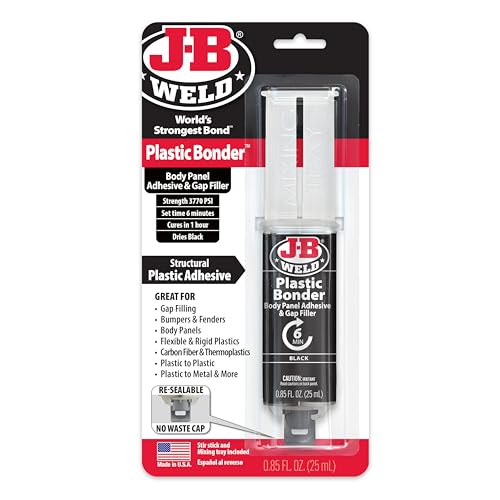 |
J-B Weld 50139 PlasticWeld Plastic Bonder Best for Cracked Trim Two-part urethane structural adhesive, 25 ml syringe, black |
8.7 | 🛒 Check Price |
 |
Permatex 84115 Black Plastic Welder Best Heat Resistance Two-part epoxy, 0.84 oz dual syringe, black, high temp |
8.5 | 🛒 Check Price |
 |
3M Headliner and Fabric Adhesive 38808 Best for Interior Trim Aerosol spray adhesive, 16.7 oz can, high-temp resistant |
8.2 | 🛒 Check Price |
1. 3M Super Weatherstrip Adhesive 08001 (Yellow): Best Overall
If you only buy one adhesive for car trim, this is the one. 3M’s yellow Super Weatherstrip Adhesive is the long-standing benchmark for reattaching rubber door seals, trunk gaskets, and window weatherstrip, and almost every other product on this list is measured against it. The nitrile rubber formula grabs fast, builds tremendous holding strength as it cures, and critically stays flexible so the seal flexes with the door instead of tearing free at the next slam.
The honest weakness is the color. It dries yellow, so if you slather it on chrome strips or light-colored trim it can show at the edges. The fix is simple discipline: apply a thin, even film to both surfaces, let it tack for a few minutes, then press together. Used that way it disappears into the seam and holds for years. The solvent odor is also noticeable, so work in a ventilated garage or outdoors.
- Formulated specifically for rubber weatherstrip and door seals on cars
- Stays flexible after curing so seals move with the body without cracking
- Brush-in-cap applicator gives controlled placement on thin trim edges
Pros: Outstanding long-term hold on rubber-to-metal and rubber-to-paint; Remains pliable in both summer heat and winter cold; Industry-standard product trusted by professional trim installers
Cons: Yellow color shows if you over-apply on visible areas; Strong solvent smell means you need good ventilation
2. 3M Black Super Weatherstrip Adhesive 08008: Best for Visible Trim
This is the same trusted 3M weatherstrip chemistry as our top pick, just in black. For the vast majority of car trim jobs, which involve black rubber door seals, dark window channels, and charcoal plastic molding, the black version is the smarter choice because there is no yellow line to hide. It bonds rubber to metal and rubber to paint with the same flexible, weather-resistant grip that has made the formula a garage staple for decades.
The trade-off is purely about how forgiving it is for beginners. Black adhesive shows up clearly while wet, and if you apply it too thickly it can string and leave smears that are tough to clean off paint before it sets. Keep the coat thin, use masking tape on either side of the seam, and let it tack before pressing. In cold conditions give it extra clamp time, because it reaches full strength more slowly than it does on a warm day.
- Same proven nitrile formula as the yellow version but dries black
- Blends into black rubber seals, gaskets and dark molding invisibly
- Resists oil, water and temperature swings once cured
Pros: Black color hides seams on most automotive weatherstrip; Strong, flexible bond that survives car washes; Easy brush application straight from the cap
Cons: Can string and smear if applied too thick; Bond can be slow to reach full strength in cold weather
3. Gorilla Heavy Duty Construction Adhesive: Strongest Grab
When you are bonding something big and heavy, such as fender flares, rocker panel cladding, or wide body cladding that wants to peel at speed, raw grab strength matters more than finesse. Gorilla Heavy Duty Construction Adhesive delivers it. The tack is aggressive enough that many trim pieces stay put with only minimal taping, and because it is gap-filling it copes with the warped or uneven backing you often find behind older plastic cladding.
It is not the tool for every job. The 9 oz cartridge needs a caulk gun, and the bead is far too heavy for thin rubber weatherstrip where you want a wiped-on film. It is also a construction adhesive at heart, so it shines on rigid plastic and metal trim rather than flexible seals. Used within its lane, on big exterior pieces that need a permanent, waterproof, paintable bond, it is hard to beat.
- Extremely high initial grab holds heavy trim without long clamping
- Fully waterproof once cured, ideal for exterior molding and flares
- Bonds plastic, metal, rubber and composite trim pieces
Pros: Massive holding power for large or heavy trim panels; Waterproof and gap-filling for uneven surfaces; Paintable after curing for a clean finished look
Cons: Needs a caulk gun for the cartridge size; Too thick for delicate thin weatherstrip work
4. Loctite Plastics Bonding System 681925: Best for Plastic Trim
Modern car trim is full of low-energy plastics, and standard super glue simply slides off polypropylene and TPO clips. Loctite’s Plastics Bonding System solves that with a two-part approach: you wipe the activator pen over both surfaces first, which primes the plastic, then apply the cyanoacrylate. The result bonds the slick plastics that defeat ordinary glue, and it sets in seconds, which makes it perfect for snapped trim tabs, broken mounting clips, and small molding repairs.
The limitation is in the name. This is a precision repair kit, not a panel adhesive. The adhesive vial is tiny, so it is meant for small bond areas rather than coating a long strip of molding. Because cyanoacrylate cures rigid, the bond can be brittle and may crack if the repaired part takes a hard flex or knock. For reattaching small plastic pieces with surgical accuracy, though, nothing else here is as quick or as clean.
- Activator primes hard-to-bond plastics like polypropylene and TPO
- Sets in seconds for fast clip and tab repairs
- Dries clear with a thin, low-profile bond line
Pros: Bonds notoriously difficult automotive plastics; Very fast set time speeds up small repairs; Clear finish is invisible on most trim
Cons: Small quantity suits small jobs, not large panels; Brittle bond can crack under heavy flex or impact
5. J-B Weld 50139 PlasticWeld Plastic Bonder: Best for Cracked Trim
Sometimes trim does not just come loose, it cracks or snaps a mounting ear clean off. That is where a structural two-part bonder earns its place, and J-B Weld’s PlasticWeld is a dependable choice. The dual syringe meters equal parts of resin and hardener, you mix, and you get a tough urethane bond that actually fills the crack and rebuilds strength rather than only sticking the surface back together. Once cured it sands flat and takes paint, so a repaired molding can look factory again.
It asks more of you than a squeeze-and-go adhesive. You have to mix it correctly, the working time is short so you cannot dawdle, and you will want clamps or tape to hold the part while it sets. For straightforward reattachment of intact trim it is overkill. But for cracked plastic, broken tabs, and damaged bumper trim that you want to genuinely repair instead of replace, this is the one that brings the part back.
- Structural two-part formula fills and rebuilds cracked trim
- Dual syringe meters an even 1-to-1 mix every time
- Sandable and paintable once fully cured
Pros: Strong enough to rebuild broken trim and bumpers; Fills gaps and cracks rather than just surface bonding; Sandable and paintable for an invisible repair
Cons: Mixing and clamping takes more effort than a one-part glue; Short working time means you must move quickly
6. Permatex 84115 Black Plastic Welder: Best Heat Resistance
Trim that lives in a hot zone, near the engine bay, on a sun-baked dashboard edge, or on dark exterior molding that bakes in summer, needs an adhesive that will not soften and let go when temperatures climb. Permatex Black Plastic Welder is a two-part epoxy built for exactly that. It bonds rigid plastic, metal, and composite trim, fills small gaps, and reaches handling strength fast, so you are not standing around holding the part for an hour.
The honest caveats are color and flex. It cures black, which is ideal on dark trim but obvious if you try to use it on light surfaces. And because it sets rigid, it is the wrong choice for soft rubber weatherstrip that needs to bend with the body. Keep it to hard trim and high-heat locations where its temperature resistance is the whole point, and it does a job the rubber-based adhesives simply cannot.
- Resists high under-hood and sun-baked surface temperatures
- Bonds and rebuilds rigid plastic, metal and composite trim
- Sets fast and reaches handling strength quickly
Pros: Holds up to high heat without softening; Strong structural bond on plastic and metal; Convenient self-mixing dual syringe
Cons: Black color limits it to dark trim if visible; Not flexible enough for soft rubber seals
7. 3M Headliner and Fabric Adhesive 38808: Best for Interior Trim
Exterior glues are only half the story, and sagging headliners, lifting door card fabric, and loose carpet on interior trim panels are some of the most common cabin annoyances. 3M’s 38808 Headliner and Fabric Adhesive is the go-to for these jobs. The aerosol lays down an even film across broad surfaces, and the high-temperature formula is designed to resist the brutal heat a parked car builds up in summer, which is exactly when cheaper spray glues let the headliner droop.
It is a specialist, not an all-rounder. The spray pattern is fantastic for large fabric and foam areas but useless for a tiny clip repair, and overspray will land where you do not want it unless you mask thoroughly first. There is a short repositioning window after you spray, so plan your placement before the surfaces touch. For headliners, door panels, and trim covered in fabric, vinyl, or carpet, it is the cleanest way to get a lasting, heat-proof hold.
- Spray application covers broad interior trim and panel areas
- High-temperature formula resists summer cabin heat buildup
- Bonds fabric, foam, vinyl and carpet to trim panels
Pros: Even spray coverage for large interior surfaces; Resists sagging in hot parked-car conditions; Repositionable for a short window after spraying
Cons: Overspray needs careful masking of nearby surfaces; Aerosol can is not suited to tiny precision repairs
Frequently Asked Questions
What is the best glue for reattaching rubber car door seals?
For rubber weatherstrip and door seals, a dedicated weatherstrip adhesive is the right tool, and 3M Super Weatherstrip Adhesive is the standard professionals reach for. The nitrile rubber formula cures flexible, so the seal moves with the door instead of cracking and letting go. Choose the black version for black seals so the bond line disappears, and the yellow version when color does not matter. Apply a thin film to both surfaces, let it tack for a few minutes, then press firmly and tape until it grabs.
Will trim glue hold up to heat, cold and car washes?
Yes, as long as you pick an automotive-rated adhesive rather than a generic household glue. Products like 3M weatherstrip adhesive, Gorilla construction adhesive, and Permatex Plastic Welder are formulated to survive the temperature swings, UV, water, and pressure that car trim faces. The key is surface prep and full curing. Clean off all wax, grease, and old adhesive, let the new glue cure for the time on the label, usually 24 hours for a full bond, and keep the car out of the wash until then.
How do I bond slick plastic trim that normal super glue slides off?
Many automotive plastics like polypropylene and TPO are low-energy surfaces that ordinary cyanoacrylate cannot grip. The solution is a system with a primer or activator, such as the Loctite Plastics Bonding System, which wipes a primer onto the plastic first so the adhesive can actually bond. For cracked or structural plastic repairs, a two-part bonder like J-B Weld PlasticWeld or Permatex Black Plastic Welder works because it mechanically keys into the surface and fills the gap rather than relying on a thin surface bond.
How long does car trim adhesive take to cure?
It depends on the type. Cyanoacrylate systems like the Loctite plastics kit set in seconds and reach usable strength within minutes. Rubber weatherstrip adhesives tack in a few minutes but want around 24 hours to reach full strength. Two-part epoxies and bonders typically handle within minutes to an hour and fully cure over 15 to 24 hours. Warmth speeds curing and cold slows it down, so in winter give every adhesive extra time and clamp or tape the part until it holds on its own.
Do I need to prep the surface before gluing car trim?
Prep is the single biggest factor in whether the repair lasts. Remove every trace of old adhesive, then clean both surfaces with isopropyl alcohol or a wax and grease remover to strip away oils, polish, and dirt that stop glue from sticking. Let the area dry completely. For glossy plastics, a light scuff with fine sandpaper gives the adhesive more to grip. Skipping this step is the number one reason trim glue fails, even when the adhesive itself is excellent.
Our Verdict
For the broadest range of car trim jobs, 3M Super Weatherstrip Adhesive 08001 is our top pick, with a flexible, weather-proof bond that has earned its reputation across decades of door seals and molding repairs, and the black 08008 version is the one to grab when the seam will be visible. If you are bonding large, heavy exterior pieces instead of rubber seals, Gorilla Heavy Duty Construction Adhesive is the runner up thanks to its aggressive grab and waterproof, paintable hold. Match the adhesive to the trim type, prep your surfaces properly, and any of these seven will keep your trim exactly where it belongs.
