Nothing kills a camping trip faster than a dead battery, a warm fridge, or a generator so loud the whole campground glares at you. The right generator for a camper has to do three things well: run quietly enough that you can sleep beside it, put out clean inverter power that will not fry your laptop or RV electronics, and stay light enough to actually lift in and out of a truck bed without a hernia.
We ran each of these units through real camping conditions, from powering a 13,500 BTU RV air conditioner on a hot afternoon to topping up house batteries overnight and keeping a portable fridge cold for days. Below are the seven best generators for campers in 2026, ranked from our top overall pick down, with honest notes on where each one falls short so you can match the right unit to how you actually camp.
| Photo | Product | Score | Buy |
|---|---|---|---|
 |
Honda EU2200i Best Overall 2200 starting watts, 1800 running watts, 48 to 57 dBA, around 47 lbs |
9.5 | 🛒 Check Price |
 |
Champion 4500-Watt Dual Fuel Inverter Generator (200988) Best for RV Air Conditioning 4500 starting watts, 3500 running watts, dual fuel gas or propane, electric start |
9.3 | 🛒 Check Price |
 |
Westinghouse iGen4500 Best Value for RVs 4500 peak watts, 3700 running watts, remote start key fob, around 53 dBA |
9.1 | 🛒 Check Price |
 |
EcoFlow Delta 2 Best Battery Power Station 1024Wh LiFePO4 battery, 1800W output, solar input, completely silent |
8.9 | 🛒 Check Price |
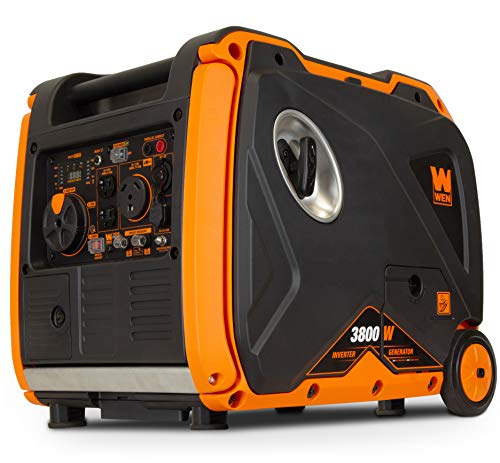 |
WEN 56380i Best Lightweight Inverter 3800 surge watts, 3400 running watts, 57 dBA, fuel shutoff and electric start |
8.7 | 🛒 Check Price |
 |
Jackery Explorer 1000 v2 Best for Tent Camping 1070Wh LiFePO4 battery, 1500W output, solar compatible, around 23.8 lbs |
8.4 | 🛒 Check Price |
 |
Generac GP3000i Best Compact Quiet Pick 3000 starting watts, 2300 running watts, PowerRush surge, around 59.5 lbs |
8.2 | 🛒 Check Price |
1. Honda EU2200i: Best Overall
The Honda EU2200i has earned its reputation as the generator campers quietly trust more than any other. The Honda GXR120 engine is famously easy to start and sips fuel in Eco Throttle mode, which dials engine speed down to match whatever you are actually drawing. In practice that meant we got most of a long evening of fridge, lights, and device charging out of a single tank, all at a hum that blends into normal campground background noise rather than dominating it. The inverter output is genuine clean sine wave, so we never worried about plugging in sensitive gear.
The honest weakness is air conditioning. A single EU2200i can run a smaller RV AC once it is going, but the startup surge on a 13,500 BTU unit will trip it more often than not, so you really want two in parallel for serious RV cooling. That doubles your investment and your carrying weight. If your camping is mostly van life, tent trips, and small trailers, one unit is close to perfect. If you live in your rig and need the AC running on demand, plan for the pair or look at a bigger single unit below.
- True sine wave inverter power safe for laptops, phones, and RV electronics
- Eco Throttle adjusts engine speed to load for long, quiet runtime
- Parallel capable to pair two units for RV air conditioner startup
Pros: Legendary reliability and starts on the first or second pull; Among the quietest generators in its class at campsite distance; Holds resale value better than almost any competitor
Cons: A single unit struggles to start larger RV air conditioners on its own; Premium positioning means you pay more for the Honda name
2. Champion 4500-Watt Dual Fuel Inverter Generator (200988): Best for RV Air Conditioning
When campers ask for one generator that just runs the air conditioner, the Champion 4500 dual fuel is the unit we point them to most. It delivers 3500 running watts, which is enough headroom to start and sustain a 15,000 BTU RV AC on its own while still leaving capacity for a fridge and a few chargers. The TT-30R outlet means you connect your 30 amp shore power cord directly, no adapters or dog bones needed. The dual fuel flexibility is the real camper feature here, since running on propane lets you tap the same tanks you already carry for cooking and store fuel for months without it going stale.
The trade off is bulk. This is not a unit you toss into a trunk one handed, and the included wheel and handle kit exists for a reason. Under a heavy cooling load it is also clearly audible, more of a steady drone than the near silence of a small Honda. For boondockers and full timers who genuinely need climate control, that noise is a fair price for self contained AC power. For minimalist tent campers it is simply more generator than you need.
- Runs a 15,000 BTU RV air conditioner from a single unit
- Dual fuel lets you switch between gasoline and propane on the fly
- Built in RV ready TT-30R outlet plugs straight into a 30 amp trailer
Pros: Enough power to cool a full size RV without paralleling; Propane option burns cleaner and stores safely long term; Quiet Start and electric start make it easy to live with
Cons: Heavy enough that you will use the wheel kit, not carry it; Louder than the smallest inverters when running under heavy load
3. Westinghouse iGen4500: Best Value for RVs
The Westinghouse iGen4500 hits a sweet spot for RV owners who want real air conditioning capacity without paying premium money. With 3700 running watts it handles a 15,000 BTU AC, a converter charging your batteries, and a fridge at the same time, and the built in TT-30R outlet plugs straight into 30 amp shore cords. The standout daily feature is the wireless key fob, which lets you start the generator from inside the rig on a chilly morning before you have even left the bed. The LED readout that shows remaining runtime is the kind of small touch that takes the guesswork out of refueling.
Where it lags the top tier is support and refinement. Owners report that when something does go wrong, getting through Westinghouse warranty service can be a slow, frustrating process, so factor that into your decision. The unit is also on the heavy side for its class, so the wheels stay attached. None of that changes the core value story: for most RV campers, this delivers the wattage and convenience of pricier units for noticeably less, and that is exactly why it lands so high on our list.
- LED data center shows fuel, power output, and remaining runtime
- Wireless remote start fob plus push button electric start
- TT-30R and dual USB outputs ready for RV and devices
Pros: Strong running wattage for the value compared to premium brands; Remote key fob start is genuinely convenient on cold mornings; Long runtime per tank for an extended weekend off grid
Cons: Customer service and warranty support can be slow to respond; Heavier and bulkier than the wattage class leaders
4. EcoFlow Delta 2: Best Battery Power Station
The EcoFlow Delta 2 is the generator for campers who hate generators. There is no engine, no gas, and no noise, just a 1024Wh LiFePO4 battery feeding up to 1800 watts of clean output. That makes it the only unit here you can safely run inside a tent or van, since it produces zero carbon monoxide. We used it to keep a 12 volt fridge cold, charge laptops and drone batteries, run a CPAP all night, and power lights and fans without ever hearing a thing. Recharge is fast too, hitting most of full in under an hour on shore power, and it accepts up to 500 watts of solar for true off grid living.
The limitation is the same as every battery station: capacity and air conditioning. The base 1024Wh will run a small AC only briefly, so this is not a climate control solution for hot trips unless you add expansion batteries and solar. Off grid, your recharge depends on sunshine or driving time, which takes planning that a gas unit does not. But for quiet, fume free, low effort power on most camping trips, nothing beats the experience of silent battery power, and that is why it earns a spot over several gas rivals.
- Zero emissions and zero noise, safe to run inside a camper or tent
- Charges to 80 percent in under an hour from a wall outlet
- Expandable with extra batteries and up to 500W of solar input
Pros: Silent operation you can sleep right next to; No fuel, no fumes, no maintenance ever; LiFePO4 cells rated for thousands of charge cycles
Cons: Cannot run an RV air conditioner for long on the base unit; Recharging off grid depends on sun or a long drive
5. WEN 56380i: Best Lightweight Inverter
The WEN 56380i is the practical middle ground for campers who want real RV wattage without the weight or expense of the big names. With 3400 running watts it will start most 15,000 BTU RV air conditioners and keep a trailer comfortable, and the TT-30R outlet makes hookup painless. Electric start gets it going at the push of a button, with a recoil cord as backup, and the fuel shutoff feature is a smart touch that runs the carburetor dry so the unit actually starts again after months in storage. For the value, the feature set punches well above its class.
The honesty here is in the build quality. The plastic shell and overall fit feel a notch below a Honda or Westinghouse, and while it has performed reliably in testing, it does not give the same bombproof impression. The fuel tank is also modest for the power on tap, so under a heavy AC load you will be refueling more often than with a larger tanked unit. Treat it as a well featured, lightweight workhorse rather than a lifetime heirloom and it delivers a lot of capability for the money.
- Electric start with a backup recoil pull cord
- TT-30R RV outlet plus 120V household and USB ports
- Fuel shutoff runs the carb dry to prevent clogging in storage
Pros: Strong wattage for the size at a friendly value; Two year warranty and a wide service network; Light enough for one capable person to manage
Cons: Plastic build feels less rugged than premium units; Tank capacity means more frequent refueling under load
6. Jackery Explorer 1000 v2: Best for Tent Camping
For tent campers and minimalist overlanders, the Jackery Explorer 1000 v2 is a near ideal companion. It packs a 1070Wh LiFePO4 battery and 1500 watts of output into a unit that weighs under 24 pounds, with a fold flat handle that makes it one of the easiest power stations to actually carry to a remote site. Operation is foolproof, just press a button and plug in, and like all battery units it runs completely silent and fume free, so you can keep it right inside the tent overnight to run a fan, charge phones, and power a CPAP without a sound.
This is firmly a small loads device, and that is the catch. It will not run an RV air conditioner, a microwave for long, or anything else hungry, so it suits tent trips and light van setups rather than thirsty RV systems. Off grid recharging leans on Jackery solar panels, which work well in full sun but slow dramatically under cloud or tree cover, so you have to plan placement. Within its lane of quiet, portable, no fuss power for camping essentials, it is an easy unit to recommend and live with.
- Light and portable battery station with a fold flat handle
- Silent, fume free power safe to use inside a tent
- Pairs with Jackery solar panels for off grid recharging
Pros: Genuinely easy to carry for a battery of this capacity; Simple, foolproof operation with a clear display; Long LiFePO4 cycle life and reassuring warranty
Cons: Output ceiling rules out RV air conditioners entirely; Solar recharge in shade or cloud can be slow
7. Generac GP3000i: Best Compact Quiet Pick
The Generac GP3000i rounds out our list as a compact, quiet inverter for campers who want clean power and portability without stepping up to the heavy RV AC units. Its standout feature is PowerRush, which delivers a burst of extra starting wattage to get motor driven gear like a small fridge or power tool spinning, even though the steady rating is 2300 running watts. The enclosed inverter design keeps noise down to campsite friendly levels, the carry handle makes it easy to reposition, and the simple LED status lights tell you instantly if you are overloaded or low on oil.
The honest limitations are start method and ceiling. There is no electric start, so you are pulling a recoil cord, which is no problem when the unit is healthy but less pleasant in cold weather. More importantly, 2300 running watts is not enough for most RV air conditioners, so this is a unit for trailers without AC, van setups, and campers powering fridges, lights, fans, and devices rather than climate control. Within that scope it is a dependable, quiet, well supported choice from a brand you can get parts for anywhere.
- PowerRush technology delivers extra starting wattage on demand
- Compact, enclosed inverter design with an easy carry handle
- Status LEDs show power, overload, and low oil at a glance
Pros: Strong starting surge for its running wattage rating; Quiet, enclosed inverter design good for campsites; Reputable brand with a broad dealer and parts network
Cons: No electric start, recoil pull only; Running wattage too low for most RV air conditioners
Frequently Asked Questions
What size generator do I need to run an RV air conditioner?
For a typical 13,500 BTU RV air conditioner you want a generator with at least 2800 to 3000 running watts, and for a 15,000 BTU unit you should look for 3500 running watts or more. Air conditioners draw a large surge at startup that is much higher than their running draw, so it is the starting wattage that catches people out. Units like the Champion 4500 dual fuel, Westinghouse iGen4500, or WEN 56380i have the headroom to start and sustain RV AC on their own. A small 2000 watt inverter such as a single Honda EU2200i generally cannot start a 15,000 BTU AC, which is why campers run two in parallel when they want both quiet and cooling.
How quiet does a camping generator need to be for campgrounds?
Most campgrounds with noise rules want generators in the 50 to 60 dBA range measured at a short distance, and many have quiet hours when no gas generator should run at all. Inverter generators like the Honda EU2200i and Generac GP3000i sit near the low end of that range at light load, which is roughly the volume of a normal conversation, while bigger units running an air conditioner climb higher. If you camp where silence matters, or you want power during posted quiet hours, a battery power station like the EcoFlow Delta 2 or Jackery Explorer 1000 v2 is the only truly silent option and is welcome anywhere.
Is a battery power station better than a gas generator for camping?
It depends on what you power and where. Battery power stations are silent, produce no fumes, need no fuel or maintenance, and are safe to use inside a tent or van, which makes them ideal for fridges, lights, fans, CPAP machines, and device charging. Their weakness is air conditioning and heavy loads, since the base units cannot run an RV AC for long, and off grid you depend on solar or driving to recharge. Gas and dual fuel generators deliver far more sustained power and can run AC indefinitely as long as you have fuel, at the cost of noise, fumes, and upkeep. Many campers end up owning both for different trips.
What does dual fuel mean and is it worth it for a camper?
A dual fuel generator can run on either gasoline or propane, and you switch between them with a simple selector. For campers this is genuinely useful, because propane stores indefinitely without going stale, burns cleaner, and often uses the same tanks you already carry for your camp stove and grill. Gasoline gives you a bit more peak power and is easy to top off anywhere, while propane is the better choice for long term standby and cleaner running. A unit like the Champion 4500 dual fuel gives you both options, so you are never stranded if one fuel is hard to find on a trip.
Can I run a camping generator in the rain or store it in my RV?
You should never run a gas generator in the rain without a vented, generator rated cover or canopy, since water and electricity are a dangerous mix and moisture can damage the unit. Position it on dry, level ground away from your sleeping area, and critically, never run a gas generator inside an RV, garage, or enclosed space because of deadly carbon monoxide. For storage, run the fuel shutoff or empty the tank so the carburetor does not clog, which is why features like the WEN fuel shutoff matter. Battery power stations have none of these concerns and can be safely operated and stored indoors.
Our Verdict
For most campers the Honda EU2200i is the generator to beat, combining near silent running, clean inverter power, and the kind of reliability that earns it a permanent spot in your rig, with the option to add a second unit when you need to run an air conditioner. If your priority is cooling a full size RV from a single machine, our runner up, the Champion 4500-Watt Dual Fuel, delivers the wattage and fuel flexibility to do it without paralleling, and campers who want zero noise and zero fumes should look hard at the EcoFlow Delta 2. Match the unit to how you actually camp and any of these seven will keep your trip powered.
