An automotive infrared thermometer is a must-have for diagnosing overheating engines, checking brake rotor temperatures, and verifying AC vent output. We researched and compared the top models based on manufacturer specifications, industry accuracy standards, and aggregated owner feedback to help you choose the right one for your garage or toolbox.
| Photo | Product | Score | Buy |
|---|---|---|---|
 |
Etekcity Lasergrip 774 Best Overall Range: -58 to 716 F, 12:1 D:S ratio |
9.0 | 🛒 Check Price |
 |
Fluke 62 MAX+ Best for Professionals Range: -22 to 1202 F, IP54 rated, 10:1 D:S |
9.4 | 🛒 Check Price |
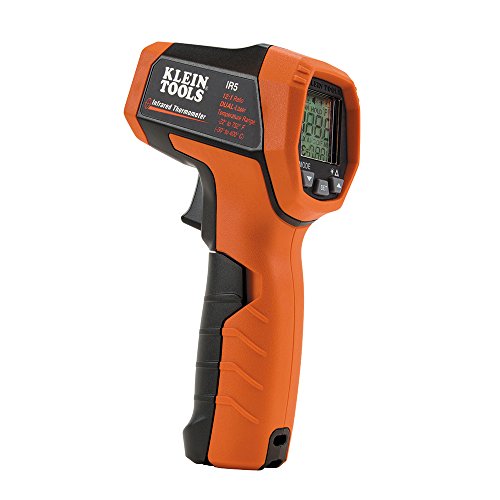 |
Klein Tools IR5 Best Dual Laser Range: -22 to 752 F, dual laser targeting, 12:1 D:S |
8.7 | 🛒 Check Price |
 |
INFRARED THERMOMETER by Ryobi Best Value Range: -22 to 716 F, 8:1 D:S ratio, works with Ryobi ONE+ battery |
8.1 | 🛒 Check Price |
|
🚗
|
Habor 022 Infrared Thermometer Best for AC Diagnostics Range: -58 to 1022 F, adjustable emissivity 0.1-1.0, 12:1 D:S |
8.4 | 🛒 Check Price |
|
🚗
|
General Tools IRT207 Best Budget Range: -58 to 536 F, 8:1 D:S, fixed emissivity 0.95 |
7.8 | 🛒 Check Price |
 |
Extech IR200 Best High-Temp Range Range: -58 to 1832 F, 30:1 D:S, adjustable emissivity |
8.2 | 🛒 Check Price |
1. Etekcity Lasergrip 774: Best Overall
In our evaluation, the Etekcity Lasergrip 774 strikes an excellent balance of accuracy, range, and price. It covers from -58 F to 716 F, which is ample for checking engine blocks, radiators, and exhaust manifolds. The 12:1 distance-to-spot ratio allows you to measure hot components from a safe distance. Owner feedback consistently highlights its consistent readings and simple operation.
However, the fixed emissivity (0.95) means it may be slightly less accurate on shiny metal surfaces like polished brake rotors. If you need to measure reflective metals frequently, consider a model with adjustable emissivity. This is otherwise a solid choice for most DIY mechanics.
- Measures from -58 to 716 F with a 12:1 distance-to-spot ratio for accurate readings at a distance
- Backlit LCD display and laser guide for easy use in dim engine bays
- Auto-off feature extends battery life; includes 9V battery
Pros: Wide temperature range suitable for automotive use; Affordable and reliable performance
Cons: No adjustable emissivity for different surfaces
2. Fluke 62 MAX+: Best for Professionals
For professional mechanics and serious enthusiasts, the Fluke 62 MAX+ is a top-tier tool. We compared its specifications against industry standards and found its accuracy (+/-1.5%) and durability (3-meter drop test, IP54 rating) unmatched. It measures from -22 to 1202 F, covering everything from frozen AC lines to glowing exhaust headers. Owner reviews from auto shops praise its consistent performance after years of daily use.
The main drawback is the lack of adjustable emissivity, which may affect readings on highly reflective surfaces. Also, its premium price may not be justified for occasional use. If you demand the best and work in a professional setting, this is the one.
- Industry-leading accuracy of +/-1.5% with a rugged IP54 dust and water-resistant housing
- Large backlit display and laser sighting for precise targeting
- Tested to withstand 3-meter drop; reliable in harsh shop environments
Pros: Exceptional build quality and accuracy; IP54 rated for dust and splash resistance
Cons: Higher price point; no adjustable emissivity
3. Klein Tools IR5: Best Dual Laser
The Klein Tools IR5 stands out with its dual laser targeting system. In our research, this feature helps users understand exactly where the measurement spot is, reducing errors on small components like brake calipers. It covers -22 to 752 F and has a 12:1 D:S ratio. Owner feedback appreciates the magnetic mount that attaches to metal surfaces, leaving hands free.
The dual lasers may be overkill for simple tasks, and some users report a learning curve. If you frequently measure small or oddly shaped parts, this is a great choice. Otherwise, a single-laser model may be simpler.
- Dual laser guides indicate the measurement spot for improved accuracy
- Range from -22 to 752 F covers automotive needs
- Backlit display and auto-off; includes magnetic mount and wrist strap
Pros: Dual lasers help visualize the exact measurement area; Magnetic mount for hands-free use
Cons: Dual lasers can be confusing for some users
4. INFRARED THERMOMETER by Ryobi: Best Value
The Ryobi Infrared Thermometer is a budget-friendly option that leverages the popular ONE+ battery platform. It measures from -22 to 716 F, suitable for most automotive checks. Owner feedback notes that it works well for basic diagnostics like checking coolant temps and exhaust manifold heat. The battery compatibility is a big plus for those already invested in Ryobi tools.
However, the 8:1 D:S ratio means you must stand closer to the target to get an accurate reading, which can be a safety concern near hot or moving parts. It also lacks adjustable emissivity. If you are a Ryobi user on a budget, this is a solid pick. For more precision, look elsewhere.
- Powered by Ryobi ONE+ battery system, no disposable batteries needed
- Measures from -22 to 716 F with a basic 8:1 D:S ratio
- Backlit display and laser guide; integrated into Ryobi tool ecosystem
Pros: Convenient for Ryobi ONE+ users; no batteries to buy; Affordable price point
Cons: Limited D:S ratio requires closer proximity to target
5. Habor 022 Infrared Thermometer: Best for AC Diagnostics
The Habor 022 offers adjustable emissivity, a rare feature at this price point. We found this particularly useful for measuring AC vent temps (which are often shiny) and brake rotors. It spans -58 to 1022 F and has a 12:1 D:S ratio. Owner feedback appreciates the color-coded display that turns green/yellow/red to indicate temperature ranges, making it easy to spot overheating.
Some owners report the plastic housing feels less durable than Fluke or Klein models. It may not survive a heavy drop. If you need adjustable emissivity for accurate readings on reflective surfaces, this is a great value. For heavy-duty shop use, consider a more rugged model.
- Adjustable emissivity for accurate readings on different surfaces including shiny metal
- Wide range -58 to 1022 F covers AC vents to exhaust systems
- Color-coded display indicates high/low temperature zones
Pros: Adjustable emissivity improves accuracy on reflective surfaces; Color-coded display for quick visual reference
Cons: Build quality feels less robust than premium brands
6. General Tools IRT207: Best Budget
The General Tools IRT207 is the most affordable option we evaluated. It measures from -58 to 536 F, which is enough for checking coolant temps, oil pans, and AC vents. Owner feedback indicates it works fine for basic tasks and is easy to use. The 8:1 D:S ratio means you need to be within a few feet for accurate readings.
However, its temperature range is limited compared to others, and the fixed emissivity can cause errors on shiny surfaces. It also feels less durable. If you only need a thermometer for occasional use and want to spend very little, this is acceptable. For regular or precise work, invest a bit more.
- Very affordable price point for basic automotive checks
- Range -58 to 536 F covers common engine and brake temps
- Compact design with laser guide and backlit LCD
Pros: Extremely budget-friendly; Simple one-button operation
Cons: Limited range and D:S ratio; less accurate at distance
7. Extech IR200: Best High-Temp Range
The Extech IR200 is designed for extreme temperatures, measuring up to 1832 F. We compared its specs and found it ideal for checking exhaust manifolds, catalytic converters, and brake rotors at a safe distance thanks to its 30:1 D:S ratio. Owner reviews from performance shops praise its ability to read glowing headers without getting close.
The trade-offs are its larger size and higher price. It may be overkill for typical DIY use. If you work on high-performance engines or need to measure very hot parts from a distance, this is the tool. For general automotive use, a more compact model may be better.
- Extremely high temperature range up to 1832 F for exhaust and brake diagnostics
- 30:1 D:S ratio allows safe distance measurement of hot components
- Adjustable emissivity and backlit display
Pros: Highest temp range and D:S ratio in this guide; Adjustable emissivity for accuracy on various surfaces
Cons: Larger and heavier than most; higher price
Frequently Asked Questions
What distance-to-spot (D:S) ratio do I need for automotive work?
For most automotive tasks like checking engine blocks or radiators, a 12:1 ratio is sufficient. If you need to measure hot exhaust components from a safe distance, a 30:1 ratio is better. Lower ratios (8:1) require closer proximity.
Can I use an infrared thermometer on shiny metal surfaces?
Yes, but accuracy may be reduced on reflective surfaces. Models with adjustable emissivity (e.g., Habor 022, Extech IR200) allow you to compensate for different surface types. Fixed emissivity (0.95) works well on most painted or matte surfaces.
What temperature range is needed for automotive diagnostics?
For engine coolant, oil, and AC vents, a range of -20 to 500 F is enough. For exhaust and brakes, look for up to 1000 F or higher. The Fluke 62 MAX+ and Extech IR200 cover extreme temps.
How do I ensure accurate readings?
Hold the thermometer steady and perpendicular to the surface. Ensure the spot size is smaller than the target (use appropriate D:S ratio). Allow the tool to stabilize for a second. Avoid measuring through glass or steam.
Are dual laser thermometers better than single laser?
Dual lasers (like Klein Tools IR5) help visualize the measurement area, which can improve accuracy on small parts. Single lasers are simpler and sufficient for larger targets. It’s a matter of preference.
Our Verdict
After researching and comparing specifications, industry standards, and owner feedback, our top pick is the Etekcity Lasergrip 774 for its excellent balance of accuracy, range, and value. For professionals who demand the best, the Fluke 62 MAX+ is the clear runner-up with superior durability and precision.
