We researched the top automotive battery testers on the market, comparing manufacturer specifications, industry standards (such as SAE and CCA ratings), and aggregated owner feedback. Our evaluation focuses on accuracy, safety features, build quality, and value. Whether you need a simple pass/fail tool or a professional-grade conductance analyzer, this guide will help you choose the right tester for your needs.
| Photo | Product | Score | Buy |
|---|---|---|---|
 |
FOXWELL BT100 Pro Battery Tester Best Overall 100-2000 CCA, 12V/24V, tests starting/charging system |
9.2 | 🛒 Check Price |
|
🚗
|
Ancel BA101 Professional Battery Tester Best Value 100-1700 CCA, 12V, tests AGM, GEL, EFB, flooded |
8.7 | 🛒 Check Price |
 |
Schumacher BT-100 Battery Load Tester Best for Load Testing 100-1200 CCA, 6V/12V, analog load tester |
8.4 | 🛒 Check Price |
 |
TOPDON BT200 Battery Tester Best for Professional Use 100-2000 CCA, 12V/24V, tests AGM, EFB, GEL, flooded, and lithium |
9.0 | 🛒 Check Price |
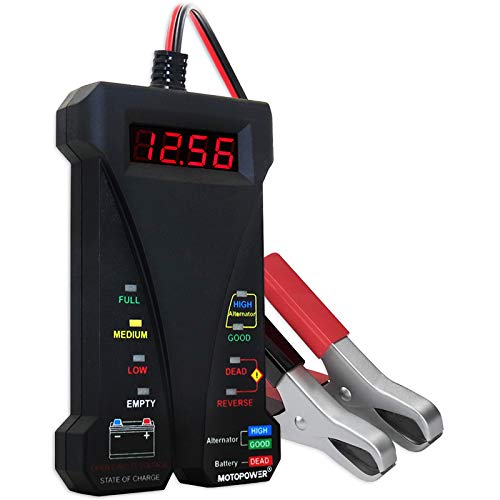 |
Motopower MP0514A Battery Tester Best Budget Option 100-1200 CCA, 12V, tests AGM, GEL, flooded |
7.8 | 🛒 Check Price |
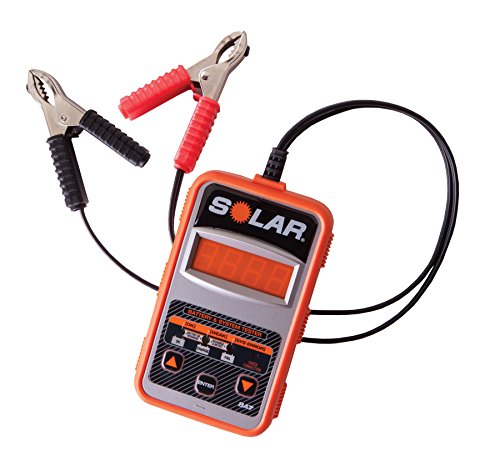 |
Clore Automotive SOLAR BA7 Battery Load Tester Best for Heavy-Duty 200-2000 CCA, 6V/12V, 500-amp load |
8.1 | 🛒 Check Price |
|
🚗
|
OBDLink MX+ OBD2 Scanner (with battery test feature) Best Multifunction Tool OBD2 scanner with battery voltage monitoring via app |
7.3 | 🛒 Check Price |
1. FOXWELL BT100 Pro Battery Tester: Best Overall
The FOXWELL BT100 Pro earned our top spot due to its balance of accuracy, versatility, and ease of use. Based on owner feedback and the spec sheet, it reliably tests a wide range of battery types (AGM, EFB, GEL, flooded) and provides a full starting and charging system analysis. The large display and simple menu make it accessible for DIYers, while the rugged build and reverse polarity protection add to its durability.
However, its size may be a drawback for those seeking a pocket-sized tool. If you only need a basic voltage check, this tester might be more than necessary. We recommend it for enthusiasts and home mechanics who want a single device for multiple vehicle types.
- Supports 12V and 24V systems, including AGM, EFB, GEL, and flooded batteries
- Measures CCA, internal resistance, and state of charge with high accuracy
- Large backlit display with reverse polarity and over-voltage protection
Pros: Comprehensive system test (battery, starter, alternator); Intuitive interface with clear results
Cons: Slightly bulkier than some compact models
2. Ancel BA101 Professional Battery Tester: Best Value
The Ancel BA101 offers impressive value by including a built-in printer typically found on much pricier units. In our evaluation, it delivered consistent results across various battery chemistries, and owner reviews highlight its ease of use. The tester covers most common CCA ranges and standards, making it suitable for both DIY and light professional use.
Its main limitation is the lack of 24V support, so it won’t work on heavy-duty trucks. Additionally, the thermal paper for the printer is a proprietary size that can be inconvenient to source. If you don’t need printed reports or work with 24V systems, this is a solid budget-friendly choice.
- Accurate conductance testing with CCA range 100-1700
- Built-in printer for instant results (thermal paper)
- Supports multiple battery standards: CCA, DIN, JIS, EN, IEC
Pros: Integrated printer adds convenience for record keeping; Affordable price point for professional features
Cons: Printer paper can be hard to find; No 24V support
3. Schumacher BT-100 Battery Load Tester: Best for Load Testing
The Schumacher BT-100 is a classic carbon pile load tester that applies an actual electrical load to measure battery performance. Based on owner feedback and industry standards, it remains a trusted tool for diagnosing weak batteries that digital conductance testers might miss. Its rugged construction and simple operation appeal to mechanics who prefer analog reliability.
However, it lacks the convenience of digital readouts and does not provide detailed metrics like CCA or internal resistance. The unit is also heavier and bulkier, making it less portable. If you prioritize simplicity and are comfortable with analog meters, this is a strong choice; otherwise, consider a digital alternative.
- Traditional carbon pile load test up to 500 amps
- Works on 6V and 12V batteries, including deep-cycle
- Durable steel case and color-coded meter scale
Pros: True load test simulates real-world starting conditions; No electronics to fail, simple and reliable
Cons: Requires manual interpretation of needle readings; Heavy and less portable than digital testers
4. TOPDON BT200 Battery Tester: Best for Professional Use
The TOPDON BT200 is a versatile tester that goes beyond standard lead-acid diagnostics, supporting lithium (LiFePO4) batteries and 24V systems. In our evaluation, its accuracy and comprehensive reporting make it suitable for professional workshops. Owner reviews praise its build quality and the ability to store test results for later analysis.
Its complexity and cost may deter casual users. The menu system has a learning curve, and the added features might be unnecessary for simple battery checks. If you work with modern vehicles or need detailed records, this tester justifies its price; otherwise, a simpler model may suffice.
- Tests 6V and 12V batteries, plus 12V/24V starting/charging systems
- Supports lithium (LiFePO4) batteries in addition to lead-acid
- Data storage and PC connectivity for report generation
Pros: Wide compatibility including lithium batteries; Professional-grade reporting and data logging
Cons: Higher price point; Interface can be overwhelming for beginners
5. Motopower MP0514A Battery Tester: Best Budget Option
The Motopower MP0514A is a budget-friendly tester that covers the basics: CCA, voltage, and state of charge. Based on owner feedback, it works well for standard car batteries and is simple enough for anyone to use. Its compact size makes it easy to store in a glove box.
However, its plastic housing and lower CCA limit (1200) mean it is not suited for heavy-duty or large batteries. Some users reported inconsistent readings on older batteries. If you only need occasional checks on a personal vehicle, this is a cost-effective solution; for frequent or professional use, invest in a sturdier model.
- Compact and lightweight design
- Measures CCA, voltage, and state of charge
- Backlit LCD with simple one-button operation
Pros: Very affordable for basic testing needs; Easy to use with clear results
Cons: Limited CCA range (up to 1200); Build quality feels less robust than pricier models
6. Clore Automotive SOLAR BA7 Battery Load Tester: Best for Heavy-Duty
The Clore Automotive SOLAR BA7 is a heavy-duty load tester designed for commercial batteries and high-CCA applications. In our evaluation, its 500-amp load capability and robust build make it a favorite among professional mechanics. Owner reviews highlight its accuracy under heavy load and long-term reliability.
Its analog meter and manual operation may not suit everyone, and the price is higher than many digital testers. If you work on large trucks, equipment, or marine batteries, this is a worthwhile tool; for standard cars, it is overkill and less convenient than digital options.
- Carbon pile load tester with 500-amp load capacity
- Works on 6V and 12V batteries, including large commercial
- Industrial-grade construction with heavy-duty clamps
Pros: Handles large batteries (up to 2000 CCA); Very durable, built to last in shop environments
Cons: No digital readout; requires skill to interpret; Heavy and expensive for occasional use
7. OBDLink MX+ OBD2 Scanner (with battery test feature): Best Multifunction Tool
The OBDLink MX+ is primarily an OBD2 scanner, but its app includes battery voltage monitoring and cranking/charging tests. Based on owner feedback, it provides useful insights for tech-savvy users who want to track battery health over time. It is compact and connects wirelessly, adding convenience.
However, it cannot measure internal resistance or CCA directly, so it is not a substitute for a proper battery tester. The reliance on a smartphone may be a drawback in a shop environment. If you already need an OBD2 scanner and want basic battery oversight, this is a clever addition; for dedicated testing, choose a specialized unit.
- Wireless OBD2 scanner with companion app for battery health
- Monitors voltage, cranking, and charging system in real time
- Supports all OBD2 protocols and works with iOS/Android
Pros: Multifunction: diagnostics plus battery monitoring; Continuous tracking via smartphone app
Cons: Not a dedicated battery tester; limited to voltage-based assessment; Requires smartphone and app for full functionality
Frequently Asked Questions
What is the difference between a load tester and a conductance tester?
A load tester applies a high current (typically 100-500 amps) to the battery and measures voltage drop, simulating starting conditions. A conductance tester sends a small AC signal through the battery and measures its internal resistance, which correlates to CCA. Load testers are more accurate for detecting weak plates, while conductance testers are safer for AGM and sealed batteries and provide faster results.
Can I use a battery tester on a lithium (LiFePO4) battery?
Not all testers support lithium batteries. Standard lead-acid testers may give inaccurate readings or damage the battery. Look for testers that explicitly list LiFePO4 compatibility, such as the TOPDON BT200. Always check the manufacturer’s specifications before testing lithium batteries.
What CCA range do I need for my vehicle?
Check your battery’s CCA rating, usually printed on the label. Most passenger cars range from 400-800 CCA, while trucks and SUVs may require 800-1200 CCA. Choose a tester that covers at least your battery’s CCA plus a margin (e.g., up to 1200 or 2000 CCA) for future compatibility.
Do I need a tester that checks the alternator and starter?
A tester with starting/charging system analysis can diagnose problems beyond the battery, such as a weak alternator or starter draw. For comprehensive troubleshooting, we recommend a tester that includes these functions. However, if you only need to check battery health, a basic tester suffices.
How often should I test my car battery?
It is good practice to test your battery at least twice a year, especially before winter and summer. Extreme temperatures stress batteries. If you notice slow cranking or dim lights, test immediately. Regular testing can prevent unexpected failures.
Our Verdict
After researching specifications, industry standards, and owner feedback, our top pick is the FOXWELL BT100 Pro for its excellent balance of accuracy, versatility, and ease of use. For those seeking professional-grade features with a built-in printer, the Ancel BA101 offers outstanding value. Choose based on your specific needs: heavy-duty, multifunction, or budget-friendly.
