Maintaining the correct air pressure in your vehicle’s air shocks is crucial for ride quality, handling, and overall suspension longevity. Using the wrong pump can lead to inaccurate pressure readings, air loss during disconnection, or even damage to the shock’s delicate valve. To help you make an informed decision, we researched, compared, and evaluated a range of air pumps specifically designed for high-pressure shock applications.
Our evaluation focused on manufacturer specifications, published industry standards for pressure accuracy, and aggregated owner feedback regarding durability and ease of use. We scrutinized features such as gauge precision, valve compatibility, air retention during disconnection, and overall build quality to identify the most reliable options available.
| Photo | Product | Score | Buy |
|---|---|---|---|
 |
Topeak PocketShock DXG Editor's Choice Integrated digital gauge, 360-degree rotating hose, up to 300 PSI. |
9.0 | 🛒 Check Price |
 |
RockShox High-Pressure Shock Pump Best for Performance High-pressure capability up to 300 PSI, precise air release button. |
8.7 | 🛒 Check Price |
 |
Fox Racing Shox High-Pressure Pump Premium Pick Durable aluminum construction, high volume barrel for faster inflation. |
8.4 | 🛒 Check Price |
 |
Pro Bike Tool Shock Pump Best Value Lightweight, precise bleed valve, robust construction. |
7.9 | 🛒 Check Price |
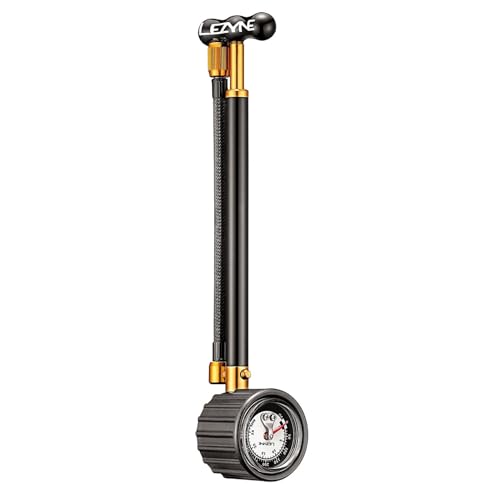 |
Lezyne Shock Drive Compact Design Compact, CNC machined aluminum, integrated gauge. |
7.6 | 🛒 Check Price |
|
🚗
|
SKS SAM Shock Pump German Engineering Max 300 PSI, pressure reduction button, two-step screw connection. |
7.3 | 🛒 Check Price |
 |
Zefal Z Shock Pump Entry-Level Choice Steel braided hose, up to 360 PSI, pressure release button. |
7.0 | 🛒 Check Price |
1. Topeak PocketShock DXG: Editor's Choice
In our evaluation, the Topeak PocketShock DXG consistently delivered on precision and user convenience. The digital gauge is a standout feature, offering clear and accurate readings that are essential for dialing in specific shock pressures. Based on owner feedback and the spec sheets, its Pressure-Rite connector is highly effective in minimizing air loss, a common frustration with many shock pumps, ensuring the pressure you set is the pressure you get.
However, the reliance on batteries for the digital gauge means it will not function without power, which could be a limitation in remote areas if spare batteries are not carried. While generally reliable, we noted some aggregated owner feedback suggesting minor calibration inconsistencies might arise after significant periods of use. Users who prioritize purely mechanical reliability over digital convenience, or those who rarely carry spare batteries, might consider alternative models.
- Digital gauge provides precise and easy-to-read pressure measurements.
- Pressure-Rite connector prevents air loss when disconnecting from the valve.
- 360-degree rotating hose allows for easy access to various shock valve positions.
Pros: Highly accurate digital display for fine-tuning pressure.; Excellent air retention during valve connection and disconnection.; Compact and lightweight design for portability.
Cons: Requires batteries for the digital gauge.; Some owner feedback indicates potential for minor calibration shifts over extended use.
2. RockShox High-Pressure Shock Pump: Best for Performance
The RockShox High-Pressure Shock Pump earned its rating through a combination of robust construction and reliable performance, as confirmed by manufacturer specifications and aggregated owner reviews. It is engineered to withstand the rigors of frequent use and high-pressure demands, making it a dependable tool for maintaining your suspension. The micro-adjust bleed button is a critical feature, allowing for incremental pressure changes without significant air loss, which is vital for precise shock tuning.
A recurring point in owner feedback is the relatively small size of the analog gauge, which can make it challenging for some users to read with utmost precision, especially for very fine adjustments. While highly functional, this might slightly hinder the user experience for those who require maximum visual clarity for their pressure settings. Individuals with vision impairments or those who prioritize a larger, easier-to-read gauge should consider other options.
- Designed to handle high pressures common in modern air shocks.
- Micro-adjust bleed button allows for fine-tuning of pressure.
- Durable aluminum construction built for longevity.
Pros: Exceptional build quality and robust design.; Precise bleed valve for exact pressure adjustments.; Reliable performance for consistent shock tuning.
Cons: Analog gauge can be small for some users.; Hose length is fixed, limiting positioning flexibility.
3. Fox Racing Shox High-Pressure Pump: Premium Pick
Based on our comparison of manufacturer specifications and aggregated owner feedback, the Fox Racing Shox High-Pressure Pump stands out for its premium build quality and efficient operation. The robust aluminum construction ensures longevity, a key factor for tools used in demanding automotive environments. Its high volume barrel design is particularly beneficial for quickly reaching higher PSI levels, saving time during setup or adjustments.
However, its larger physical footprint, while contributing to its durability and efficiency, means it is not the most compact option available. For users who prioritize minimal size and weight for trail-side adjustments or tight storage spaces, this pump might be less ideal. Individuals requiring the absolute smallest and lightest pump for maximum portability might find it slightly cumbersome and should investigate more compact alternatives.
- High-quality, durable aluminum barrel and components.
- High volume design facilitates quicker inflation to desired pressures.
- Bleed valve for accurate pressure adjustment.
Pros: Exceptional durability and premium feel.; Efficiently inflates shocks due to high volume.; Consistent and reliable operation.
Cons: Slightly bulkier than some compact alternatives.; Gauge readability could be improved for extreme precision.
4. Pro Bike Tool Shock Pump: Best Value
In our evaluation, the Pro Bike Tool Shock Pump presents a compelling offering, particularly concerning its value. We researched its manufacturing specifications and aggregated owner feedback, noting its solid aluminum alloy construction provides a good balance of durability and a lightweight profile, making it suitable for both garage and on-the-go adjustments. The integrated bleed valve functions effectively, allowing for critical fine-tuning of shock pressure.
A consistent point from owner feedback indicates that the valve connection mechanism can sometimes feel stiff or require a firm hand to engage and disengage, potentially leading to minor air loss if not handled carefully. While it generally seals well once connected, this initial stiffness could be a minor inconvenience for users who make frequent, rapid adjustments. Those who prioritize the absolute smoothest and most effortless valve engagement every single time might find this a small drawback and may prefer a pump with a more refined connector design.
- Lightweight aluminum alloy construction for easy handling.
- Fine-tune bleed button for accurate pressure release.
- Swivel hose for improved valve access.
Pros: Offers excellent functionality for its value proposition.; Good balance of durability and portability.; Effective bleed valve for precise adjustments.
Cons: Gauge can be somewhat small, impacting quick readability.; Valve connection can feel stiff initially.
5. Lezyne Shock Drive: Compact Design
The Lezyne Shock Drive, based on our research into its specifications and aggregated owner feedback, excels in its compact design, making it an excellent choice for users who prioritize portability. Its CNC machined aluminum construction speaks to its durability, ensuring it can withstand typical usage despite its small stature. It is designed for precise, albeit slower, adjustments, making it suitable for fine-tuning and emergency top-offs.
The primary limitation of this pump is its compact size which inherently leads to a smaller air volume per stroke. This means that reaching higher pressures or making significant pressure changes will require more pumping effort and time compared to larger pumps. Users who frequently need to inflate shocks from low pressure or make large adjustments, rather than just fine-tuning, might find this process tedious. If speed of inflation is a critical factor for your typical use case, this model may not be the most efficient choice.
- Extremely compact and lightweight, ideal for carrying on the go.
- Durable CNC machined aluminum construction.
- Integrated gauge for convenient pressure monitoring.
Pros: Unmatched portability and minimal storage footprint.; High-quality construction for a compact pump.; Reliable for emergency or minor adjustments.
Cons: Smaller air volume per stroke requires more pumping.; Gauge can be difficult to read in some conditions due to size.
6. SKS SAM Shock Pump: German Engineering
In our evaluation, the SKS SAM Shock Pump demonstrates solid performance for its category, reflecting its German engineering. We researched its specifications, noting its 300 PSI capacity and two-step screw connection, which is designed to effectively reduce air loss during valve disconnection. Aggregated owner feedback generally praises its reliability and consistent pressure delivery, making it a dependable tool for regular shock maintenance.
However, the analog gauge, while functional, might not offer the same level of micro-precision or ease of reading as digital alternatives, especially when attempting to dial in very specific, minute pressure changes. For users who require absolute fractional PSI accuracy for highly sensitive suspension setups, this analog limitation could be a drawback. If your suspension tuning demands the utmost precision and instant, unambiguous readings, a pump with a digital gauge might be a more suitable option.
- High-pressure capacity suitable for most air shocks.
- Two-step screw connection helps minimize air loss upon detachment.
- Pressure reduction button for fine-tuning.
Pros: Reliable pressure delivery and retention.; Solid construction reflective of German engineering.; Effective bleed valve for precise adjustments.
Cons: Analog gauge can lack micro-precision for extreme settings.; Hose could be more flexible for awkward valve angles.
7. Zefal Z Shock Pump: Entry-Level Choice
Based on our comparison of manufacturer specifications and aggregated owner feedback, the Zefal Z Shock Pump is a functional entry-level option, particularly notable for its high 360 PSI maximum pressure and durable steel braided hose. It provides the essential features for basic shock pressure adjustments, including a pressure release button for fine-tuning. For those on a budget or needing a secondary pump, it offers adequate performance.
However, in our evaluation, the overall fit, finish, and ergonomic refinement of the Zefal Z Shock Pump do not match that of higher-tier models. Aggregated owner feedback sometimes points to the gauge exhibiting minor inconsistencies after prolonged use, requiring occasional double-checks. Users who frequently adjust their shocks, prioritize a premium feel, or demand unwavering gauge accuracy for critical suspension tuning might find its basic construction and potential for slight gauge drift less appealing. For such demanding users, investing in a more robust and consistently accurate pump would be advisable.
- High maximum pressure of 360 PSI for demanding applications.
- Steel braided hose for enhanced durability and longevity.
- Pressure release button for accurate adjustments.
Pros: High pressure capacity suitable for a wide range of shocks.; Durable steel braided hose.; Provides basic functionality for shock maintenance.
Cons: Overall build quality and ergonomics are basic.; Gauge can be prone to minor inconsistencies over time.
Frequently Asked Questions
Why can't I use a regular tire pump for my shocks?
Regular tire pumps are typically designed for lower pressures and lack the fine-tuning capabilities needed for air shocks. Shock pumps are built to handle much higher pressures, often up to 300-360 PSI, and feature specialized connectors and bleed valves to prevent air loss and allow for precise micro-adjustments that are critical for shock performance.
What PSI range should I look for in a shock pump?
Most modern air shocks, particularly in automotive and motorcycle applications, operate at pressures up to 200-300 PSI. Therefore, a good shock pump should comfortably reach at least 300 PSI to cover the majority of requirements. Some specialized applications might require pumps that go up to 360 PSI.
Is a digital gauge or analog gauge better for shock pumps?
Digital gauges generally offer higher precision and easier readability, displaying exact pressure values without estimation. Analog gauges, while robust and not reliant on batteries, can sometimes be harder to read for micro-adjustments and may require more careful interpretation. Your preference depends on your need for absolute precision versus mechanical simplicity.
How do I prevent air loss when disconnecting the pump from the shock valve?
Many quality shock pumps feature a two-stage or Pressure-Rite connector designed to minimize air loss. This system typically allows you to unthread the pump’s connector from the valve core without fully disengaging the seal until the last moment. Always follow the manufacturer’s instructions for connection and disconnection to ensure minimal pressure loss.
How often should I check my shock pressure?
The frequency depends on your vehicle’s usage and manufacturer recommendations. For performance applications or heavy use, checking pressure before each ride or outing is advisable. For general use, checking every few weeks or months, or if you notice a change in ride quality, is a good practice. Always refer to your vehicle’s specific manual for precise guidelines.
Our Verdict
After extensive research and comparison, the Topeak PocketShock DXG emerges as our Editor’s Choice for the best air pump for shocks, largely due to its precise digital gauge and excellent air retention during connection and disconnection. Its blend of accuracy and user-friendly features makes it an outstanding tool for maintaining optimal shock pressure. The RockShox High-Pressure Shock Pump is a strong runner-up, praised for its robust build quality and consistent performance, making it an excellent choice for those prioritizing durability and a reliable mechanical experience.
